
Chaos: Charles Manson, the CIA, and the Secret History of the Sixties
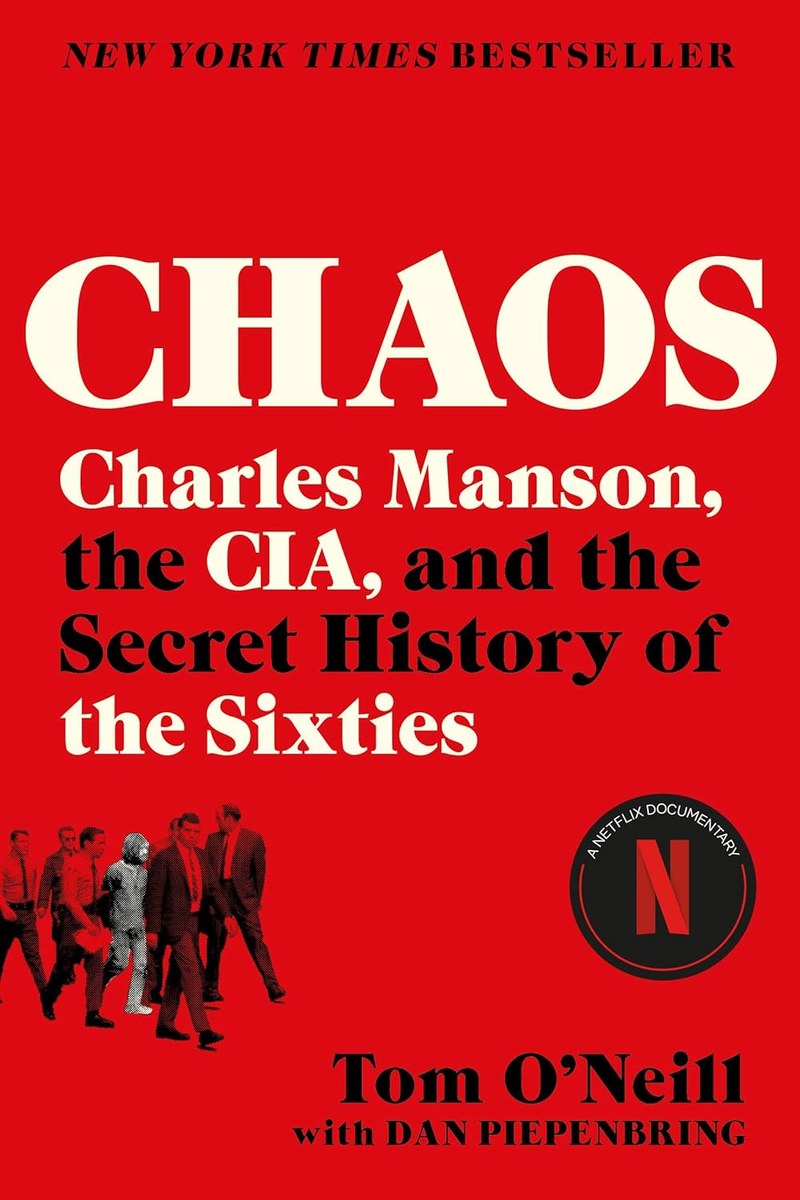
The Tate-La Bianca Murders, orchestrated at the behest of crazed LSD cult leader Charles Manson, are one of the defining crimes of the 20th century, ending the innocence of the 60s in an orgy of violence. Tom O’Neill was assigned to write a magazine piece in 1999 on the 30th anniversary of the murders. His reporting led him into a wilderness of mirrors, of uncanny coincidences and official denials, that crosses into the land of conspiracy. In this book, O’Neill takes us through his journey down the rabbit hole.
The book opens with a 2006 confrontation between O’Neill and Manson family prosecutor Vincent Bugliosi. Bugliosi was a politically ambitious district attorney whose 1974 book Helter Skelter is the best selling true crime book of all time and defined the basic premises of the case: Manson’s charismatic domination of his followers, his twinned motives of terrifying record producer Terry Melcher and sparking an apocalyptic race war as prophesied in The Beatles’ White Album. Proving Manson’s culpability is not all that straight forward. While his followers gleefully confessed, the case had to thread a needle that proved Manson’s direct responsibility via his powers of mental domination and the culpability of the people who wielded the knives. Helter Skelter was a best seller, and as O’Neill did his research, he discovered that Bugliosi’s book, and more importantly his case, were full of holes, errors in timelines, and key omissions.
The first section of the book focuses on Hollywood in the 60s, and the “live freaky die freaky” attitude of the community around Tate and Polanski. Roman Polanski was an abusive husband, and the scene at Cielo Drive was much uglier than popular memory depicts. In this swirl of gossip, with drug deals and mob ties, the key fact that O’Neill uncovered is that contrary to Bugliosi, Terry Melcher knew Manson more closely than he stated on the stand. Melcher never signed Manson to a record deal, but he saw Manson multiple times after the murders, and witnesses remember him begging for forgiveness.
The second weirdness is around the police. Prior to the murders, Manson had spent years in Federal prison. He was out on parole, a known figure of interest, and he should have been in jail for numerous mundane crimes like car theft, drug possession, shooting a drug dealer, and the whole underage-rape-sex-cult thing. The LA Sheriff’s Department made a massive raid on Spahn Ranch, where The Family was hiding, days after the murder, but Manson and his followers were not held, and spent months on the lam in Death Valley.
Police incompetence is not a surprise, but this is a lot. O’Neill argues that Manson had legal protection and that he was likely an informant. Records of this, if they still exist, have not been released, but even fear of reputational damage seems excessive. What is known in general terms is that multiple police and intelligence agencies, including locals in LA, the FBI through COINTELPRO, and the CIA through a project called CHAOS, all had efforts to infiltrate Leftist groups and sabotage/neutralize them. Getting the Black Panthers to trade shots with anyone and everyone was a key strategic objective across the forces of law and order.
And then the story gets uncanny. Manson was on parole, and his parole officer was Dr Robert Smith, a San Francisco-based pharmacologist working at UC Berkeley on the effects of LSD and amphetamines on violence in rodents, with a sideline in the practical applications of this research. Robert Smith was one of the founders of the Haight-Ashbury Free Medical Clinic (HAFMC) in 1967, and Manson became Manson during the summer of love, spending a lot of time dropping acid and hanging around the clinic with Smith and his girls. Robert Smith was unusually lenient and protective of Manson for a parole officer, and in a six hour interview offered vague denials for his actions during this period.
At the same time during the Summer of Love, the HAFMC hosted Dr Louis “Jolly” West, who is one of the more shadowy figures of the 20th century. O’Neill dug through West’s papers at UCLA, finding a smoking gun of ties between West and Sidney Gottlieb, the director of the CIA’s MKULTRA. West was one of the foremost researchers on mind control and on the use of LSD to erase memories, and implant false memories.
There’s no evidence that West and Manson ever met, unfortunately, but West was connected with a lot of weird incidents (which by the way did not come up in Lemov’s The Instability of Truth, which covered quite a lot of West’s career.) West was an expert witness in the trial of Jimmy Shaver, an Air Force technician who was convicted of raping and murdering a three year old girl in 1954. Shaver had no memories of the incident, which West recovered with hypnosis and sodium pentothal. Shaver also suffered from migraine headaches, and the base psychiatrist who would have treated him was one Dr. Louis “Jolly” West. Again, there’s no evidence for direct involvement, the Lackland Air Base medical records for 1954 are incomplete, with last names S-Sh missing. West also showed up in a similar way during the Kennedy assassination. He interviewed Jack Ruby, the man who shot Oswald. According to O’Neill, prior to contact with West, Ruby had no memory or motive for why he shot Oswald, but was otherwise coherent. After meeting West, Ruby was broken, paranoid, psychotic. Could West have manipulated Manson as well?
The book closes out with the likely police cover-up of another Manson murder near Death Valley, where a young Italian man’s death was recorded as a suicide by local cops, despite numerous inconsistencies in the record. Why would Bishop Police be involved in all this? I genuinely have no idea, but they appear more incompetent than typical for rural cops.
O’Neill describes himself as a lousy conspiracy theorist. He admits any explanation of the Manson murders is overdetermined: Can it plausibly be a drug deal gone wrong, LAPD counter-insurgency, and CIA mind control all at once? Not really, but the “official” story is somehow even less true. I wonder if Manson is a uniquely unstable historical nexus, or if somehow any event disintegrates under close examination? Unfortunately, we’ll likely never know, as old age comes for the remaining witnesses.
Utterly compelling, Chaos is a unique study of both the 60s and the research process.