
Impro: Improvisation and the Theatre
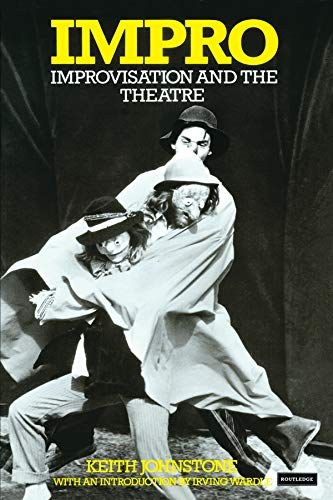
Impro is one of those absolute classics. These days improv is both foundational to every bit of comedy you like and also shorthand for being too lazy and disorganized to pay writers or generally a tedious mess. But improv started as a liberatory and transgressive avant-garde program, and Johnstone was one of the originators.
Abbi and Ilana from Broad City have a disastrous evening at an improv show.
The book is framed around four major sections: status, spontaneity, narrative, and masks and trance, with Johnstone’s experiences in British education and theater serving as a through-line.
The first section, status, is the best and most provocative. Johnstone notes that people are keenly aware of social status. We have a preferred status to play and instantaneously learn to size up a social situation to see where we fit in. For a dramatist, this has several implications. Drama is only alive if the play of social status is apparent and realistic: a play can have the best writing imaginable, but will die on stage if the actors fail to embody real social status. Learning to play different social statuses is a critical skill for actors. Good drama can be created simply by having four roles in a hierarchy of status and saying “transmit messages up and down.” Even the most egalitarian societies get the humor of master and servant and the humor of inverting the status roles.
Spontaneity is perhaps the skill most associated with improv, and the goal here is undoing all the damage of education. In Johnstone’s estimation, people spend immense amounts of effort maintaining a personality and trying to appear normal. This effort makes them hesitant and inauthentic. Don’t try to be clever, just say literally the first thing that comes to mind. One of the more interesting exercises with people who claim that they’re not creative is collaborative story-telling. The trick is that the prompter says that he already has the story, the uncreative partner just needs to guess what it is, and the prompter will answer with yes or no. Of course, there is no pre-planned story, and the answers are made by something as arbitrary as the last letter of the sentence being a vowel or consonant. A person who claimed to be uncreative told a truly novel story about post-apocalyptic insect societies just by chasing the illusion of an answer.
The narrative and mask sections are the weakest of the book, and even though they are freshest in my memory they are difficult to summarize and draw lessons from to the same extent that status and creativity stuck with me. Narrative is always based around patterns, and an interesting narrative is about patterns being broken. Brain surgeons doing surgery is not a good premise; brain surgeons taking out the trash is. Narratives have their own logic and internal poetry, which we understand. Johnstone is also a major proponent of mask-work, which he sees as a route to trance-states and true embodiment of another persona, not merely pretending to be someone else.
Impro is a fascinating book, and is apparently having a moment with Silicon Valley types. I heard about it from post-Rationalist life advice blogger, which is a group of people with a lot of interesting ideas, and a real problem distinguishing the good ideas (just do things) from the bad ones (march for billionaires). The author of the New York Times op-ed, Aaron from Life Improvement, and I all attended Vibecamp, though I don’t think I met either of them in the flesh. Capital-R Rationalism and its post-Rat clades are very much about self-improvement, and treating social interaction as a game is one way to start winning, especially for neurodiverse folks who are punished for breaking rules that seem both invisible and inconsistent. Further, the effort used to maintain that facade of normal personality is effort that could be better devoted towards your start-up, or doing drugs, or your start-up that laser-beams good trips into people’s eyeballs.
Improv done properly is about diving into the vast collective unconscious and emerging with pearls of radical authenticity. That improv is funny is a side-effect of how immensely artificial modern society is. Using Johnstone’s frameworks to persuade Y Combinator to invest in a startup feels sacrilegious, but that’s what people want to do with their lives. I think insights into how and why to perform interesting stories are far more valuable, and Impro is a fantastic book for that.
—Addendum: A close friend of Keith Johnstone who works in theater wrote a response which is worth reading. To extend his argument, status is a social transaction and playing low status can be a very potent move, which Johnstone did often. High status is about domination, and the reality distortion field venture capital attempts is about rejecting reality, rather than accepting and playing with it as improv does. In particular, the contract of improv can be broken by any participant at any time and this is what makes it safe. Rejecting that essential consent turns creativity into exploitation.