
Planet of Exile
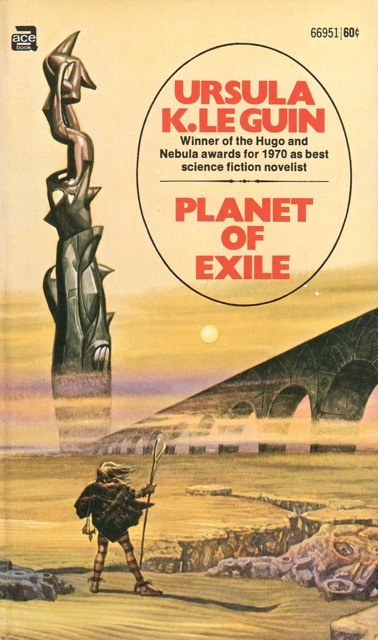
Planet of Exile shows Le Guin’s growing confidence as a writer, with an interest in ecological and sociological matters. Werel/Gamma Draconic III is defined by its 60 Terran-year elliptical orbit, which gives it a seasonal cycle that matches a human lifespan. Winter is coming, and the standard preparations of the local Tevaran tribe and abandoned League of All Worlds colony Landin are interrupted by the arrival of nomadic Gaal. This season, the Gaal have united under a charismatic warlord, and rather than bypass fortified cities they are sacking and enslaving them.
The main characters are the elderly Wold, the great man of the Tevarans, his wayward and curious daughter Rolery, and leader Jakob Abat of the Landiners. Jakob and Rolery fall in love, despite taboos that divide their two cultures and genetic differences which mean they’ll never have children. There is a desperate war against the horde of Gaal, and finally the hard triumph of survival.
Wold, Rolery, and Jakob are all much more finely drawn characters than the romantic stereotypes of Rocannon’s World. There’s a great sorrow in Jakob and the Landiners, a once proud and intelligent people on the edge of extinction because the biochemistry of the world wants them dead and few of their children survive. The Tevarans are stubborn, but have some sharp touches in their use of “I listen” as a cultural marker of respect, shrugs for yes, and particularly the rite of stone-pounding which opens their councils, where the chaos of many people banging rocks together must fall into sync before debate can begin.
The romance between Rolery and Jakob is somewhat arbitrary, he mindspeaks her to save her from being caught in a deadly tide, and this creates a bond which means they’ll either love each other or kill each other, but for its arbitrary beginning it has a realistic weight of infatuation and appreciation. The basic plot, with winter coming, the threatening Gaal, who are atypically for Le Guin impossible to communicate with despite having both society and culture, and the climactic siege, all work well. The ecology of Werel is novel and sets the stage for much of what is to come. And in one nice touch, both Landin and Tevar say that they’re human, and the other ones are inferior aliens. The word we use to refer to ourselves always just means “people.”