
Say Nothing: A True Story of Murder and Memory in Northern Ireland
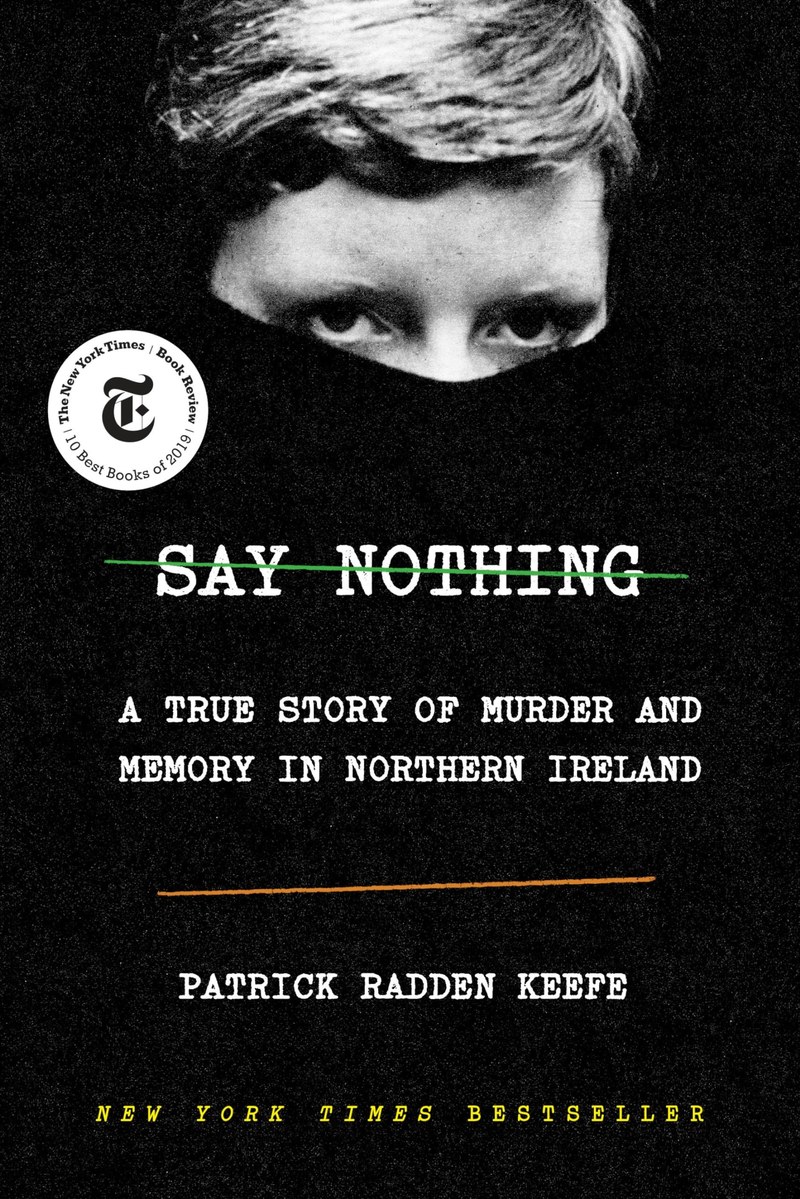
Say Nothing is a triumph of narrative non-fiction. Keefe frames his history of The Troubles through the 1972 disappearance and murder of Jean McConville, a widowed mother of 10 alleged to be an informer, the career of IRA fighter Dolours Price, and the cipher of Gerry Adams. This is a book about what everybody knows and refuses to acknowledge, and about how the ghosts of history keep turning up to haunt the present.
The Troubles can be seen as the 60s and 70s spark of the long war between the Irish and the British. When Ireland broke from the Empire in 1921, the mostly Protestant north did not. The minority Northern Ireland contained its own minority of discriminated Catholics. One notable thing about the Troubles was how compressed they were. Belfast, a city with 650,000 residents, feels like a small town where everybody knows everyone else. You can be school friends with a major political figure, or run into the person who abducted your mother in a cab. There is no escape, and even knowing this, locals are drawn back to the city by psychological magnetism.
Price was a teenager in the 60s, the child of an IRA fighter. She turned to violence after a march to Derry inspired by Martin Luther King Jr was ambushed and assaulted by Unionist thugs with the complicity of the police. Dolours and her sister Marian rose through the ranks as gunwomen, pulling off daring bank robberies wearing blond wigs and sunglasses and becoming members of the elite “Unknowns” squad. The sisters were arrested in the aftermath of the 1973 Old Bailey bombing, entering a decade of imprisonment and hundreds of days of hunger strikes.
Meanwhile, Jean McConville’s disappearance shattered her family. The 10 children were scattered to various abusive orphanages. A body would have been awful, but would at least have provided closure.
From these two anchors, Keefe examines the spectrum of IRA strategy, the dual “Armalite and ballot” method which blended violence and politics, and the murky world of counter-insurgency. The British Army had stepped into Northern Ireland to ostensibly separate the factions, but quickly became a participant. The British Army, its experience honed by centuries of colonial wars, most recently in Malaysia and Kenya, developed a strategy based around intelligence and informers. Keefe alleges that the most senior of these informers, “Steak Knife”, was the head of the IRA’s internal security unit, The Nutting Squad, and that British intelligence is responsible for dozens of secret murders. And for all that the IRA was ostensibly about protecting the Catholic community, many of its operations were random bombings or brutal internal security assassinations.
Gerry Adams, a central founder of the political party Sinn Féin, is the counter to the power of the British state. A charismatic politician, Adams has always been skilled in dissembling on violence and his role in it. He’s always denied being an IRA member, but everyone knows that not only was Adams in the IRA, he was the commander of the Belfast Brigade. Nothing happened without his knowledge or approval.
And this “nothing” included brutal realpolitik, like murder and disappearance for informers, and possibly letting Bobby Sands and six other hunger strikers starve to death, because even though there was a deal on the table, martyrs were worth more to the cause.
The Good Friday Agreement, engineered by Adams, created a brittle peace which left major issues unresolved. Belfast is still divided by massive concrete “Peace Walls”, the internal ethnic cleansing into Protestant and Catholic neighborhoods never undone. Unlike South Africa’s Peace and Reconciliation process, the status of crimes committed during the struggles was never addressed.
This exploded in The Belfast Project, an oral history of the Troubles carried out by Boston College, where many fighters on both sides confessed to serious crimes like murder and terrorism. Intended to be an archive for the future, The Belfast Project became a political football used in criminal prosecutions.
This book deserves all its accolades. I’m strictly an amateur in this area, but it approaches Neil Sheehan’s A Bright Shining Lie as an essential history.