
The British Are Coming: The War for America, Lexington to Princeton, 1775-1777
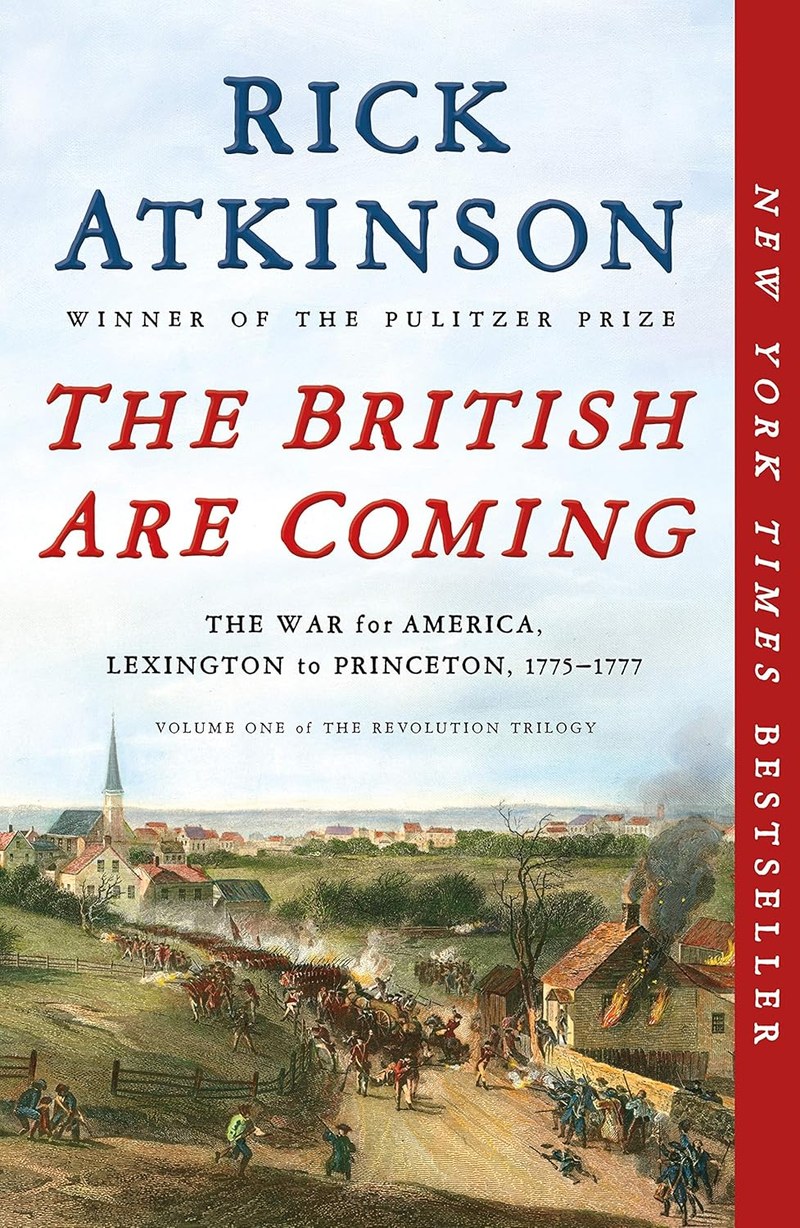
What with the 250th anniversary of the Declaration of Independence, I figured it was time to broaden my horizons to the American Revolution. I’m not familiar with Atkinson, but he’s a highly regarded journalist turned military historian who’s won a boatload of prizes.
This approaches the war on an individual, humanistic level. Unusually, the first individual is King George III, at the height of his power, with his 1773 birthday review of the fleet. Usually cast as a brutal tyrant and madman, the King George of the revolution was detail oriented and involved. Unlike his German forebears, he was born in England, had English as his first language, and in fact had a thoroughly British provincial conservatism, which exacerbated the political differences between Britain and the colonies.
From 1773, Atkinson skips through the political issues and begins with the British occupation of Boston, and the subsequent battles of Lexington and Concord. The British plan was simple: flatten the enemy center of gravity, gain support from loyal locals, teach the rebels some manners. And it was as poorly executed as could be.
The British found little local support, and the excursion to Lexington and Concord to seize military stores played into the best strengths of the minutemen militias. Thousands of locals swarmed the British column, sniping from behind trees and stone walls, targeting officers and dealing hundreds of casualties. At the Battle of Bunker Hill, the same militias stood up to regulars, ceding the ground at a high cost.
I won’t go into a full blow by blow, but both sides suffered major reverses to their objectives. The British were constrained by the difficulties of expeditionary warfare across the Atlantic in the age of sail. Orders arrived weeks out of date, provisions arrived rotten or not at all. The British command was often divided and ineffective, failing to close and destroy the enemy.
The American side was short of every military store, especially gunpowder and heavy cannons. At this point, most troops were militia on short term enlistments and the army was perennially rotating away. There were almost no military professionals, everyone including Washington was still very much learning as they went. The Colonial congress was disorganized and broke, which created comparable logistical difficulties.
Both sides experienced failures in strategic sideshows. The American invasion of Canada was an utter fiasco that saw an army destroyed by disease and the embitterment of Benedict Arnold. British attempts to shore up loyalists in the southern colonies only succeeded in widening the war to areas less politically motivated; freeing and arming Black slaves was a red line for the southern planter class.
For the main campaign, the Americans won at the Siege of Boston by emplacing heavy guns on Dorchester Heights. Washington then moved his army to New York, where he failed to defend the region and was pushed into New Jersey, keeping the Army intact by the skin of his teeth. What saved the Revolution was a series of audacious actions in the winter of 1776/1777, when Washington led troops across the frozen Delaware to win sharp blows at Trenton and Princeton. These dramatic victories bolstered American support at home and abroad, and forced the British back to a tiny strip of New Jersey for winter quarters.
Each side had learned sharp lessons, but the Americans had learned a little faster. As I mentioned, this is a personal account of the Revolution. Atkinson of course focuses on major figures like Washington and Franklin and Howe, as well as junior officers who would rise to greatness like Alexander Hamilton and James Madison, but he takes plenty of room to describe ordinary men and women suffering, with excerpts from letters home, diaries, and descriptions of death in battle.
Atkinson doesn’t quite rise to the highest tier of grand history, like Ian Toll’s Pacific War trilogy or McPherson’s Battle Cry of Freedom: The Civil War Era, mostly due to a relative disinterest in the intellectual and political aspects of the Revolution. However he avoids a much more common hagiographic trap, and these are engaging and detail filled stories.