
The Golden Road: How Ancient India Transformed the World
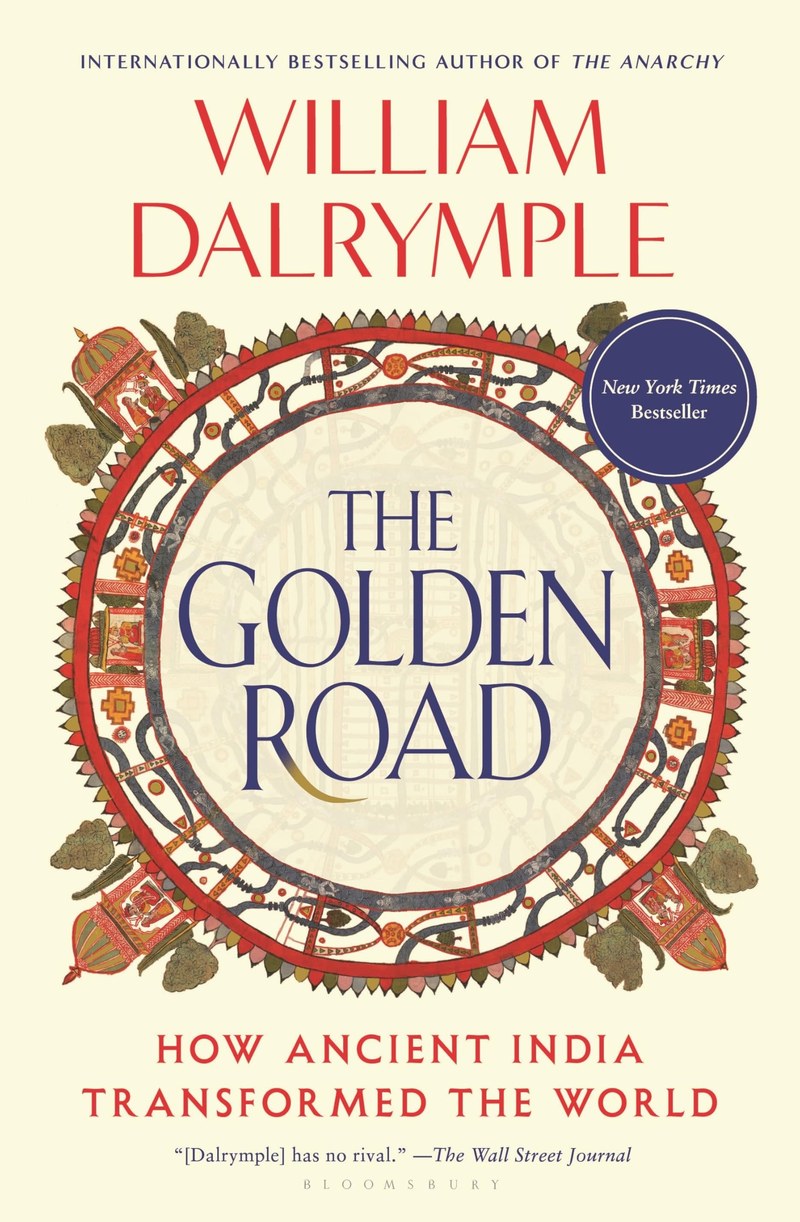
The Golden Road is a sprawling, if disconnected, account of the influence of Indian culture around the world from roughly 500 BC to 1300 AD. Dalrymple makes a convincing case for Indian influence. And while this may be a case of wanting another book, India itself is a void, glimpsed through its scientific, cultural, and material exports.
While evidence for links between Rome and China is rather sketchy, Rome and India were great trading partners, linked via the Red Sea and Egypt. Roman writers like Pliny and Tacitus complain about Roman gold flowing to India for frivolous luxuries like pepper and silk. Perhaps a third of the Imperial treasury was funded by duties on this trade. Meanwhile, hoards of Roman coins are common discoveries in Indian archeological sites, and Indian temples were decorated by sculptors with names like Justinian Flavius. While this trade was continued past the fall of the Western Roman empire, the Muslim conquest of Egypt resulted in a re-orientation of Indian trade to the east and north, through the straits of Malacca and up to China.
Along with luxury goods, the other great concrete export of India was expertise. Indian astronomers, astrologers, mathematicians, and doctors were renowned across the world. ‘Arabic’ numerals are in fact Indo-Arabic numerals, and the use of zero and the decimal point are both Indian innovations foundational to math. While Ancient Greeks are at the foundation of modern mathematics, evidence suggests that Indian mathematicians of the same period were equally, if not more, sophisticated.
The third great export was religions. Buddhism and Hinduism are both Indian innovations, with some of their greatest accomplishments far from home. Borobudur and Angkor Wat are two of the greatest religious sites humanity has ever produced, Indian cultural wonders produced outside of the subcontinent. India was the pilgrimage site for Chinese Buddhist monks, who played an especially central role in the rule of Chinese Empress Wu Zetian. Of course, history is written by the victors, and the profoundly misogynistic Confucians who wrote the histories of her reign cast her as a great villain.
The Indosphere declined under the blows of Islamic invasion from what is now Afghanistan, and refugees from Mongol conquests. The Ghurid Empire and Delhi Sultanate were much less accommodating to religious diversity than previous Indian rulers, razing many ancient Buddhist libraries and monasteries. Unlike previous conquerors, they were uninterested in Sanskrit, and Persian became the court language. This trend was reinforced by Central Asian refugees speaking other Persian tongues, the hostility of the Mongol Empire to the north, and the creation of the Silk Road under the Pax Mongolia. And for various reasons (local prosperity, Hindu taboos, etc), Indian sailors never developed the globe spanning ships that saw Europeans arrive in the 17th and 18th centuries, with disastrous consequences detailed in The Anarchy.
There are some key gaps. While Dalrymple has quite a lot to say about the rise of Buddhism, the rise of Hinduism is basically elided. Visual arts are described with great care, written Sanskrit is passed over. And I was personally annoyed that the claims of Buddhist holy men were taken at face value, even when they included things like “summoning an army of ghosts to defeat a very physical army of barbarians.” This book is fine, but I learned less than I wanted to.