
The Wide Wide Sea: Imperial Ambition, First Contact and the Fateful Final Voyage of Captain James Cook
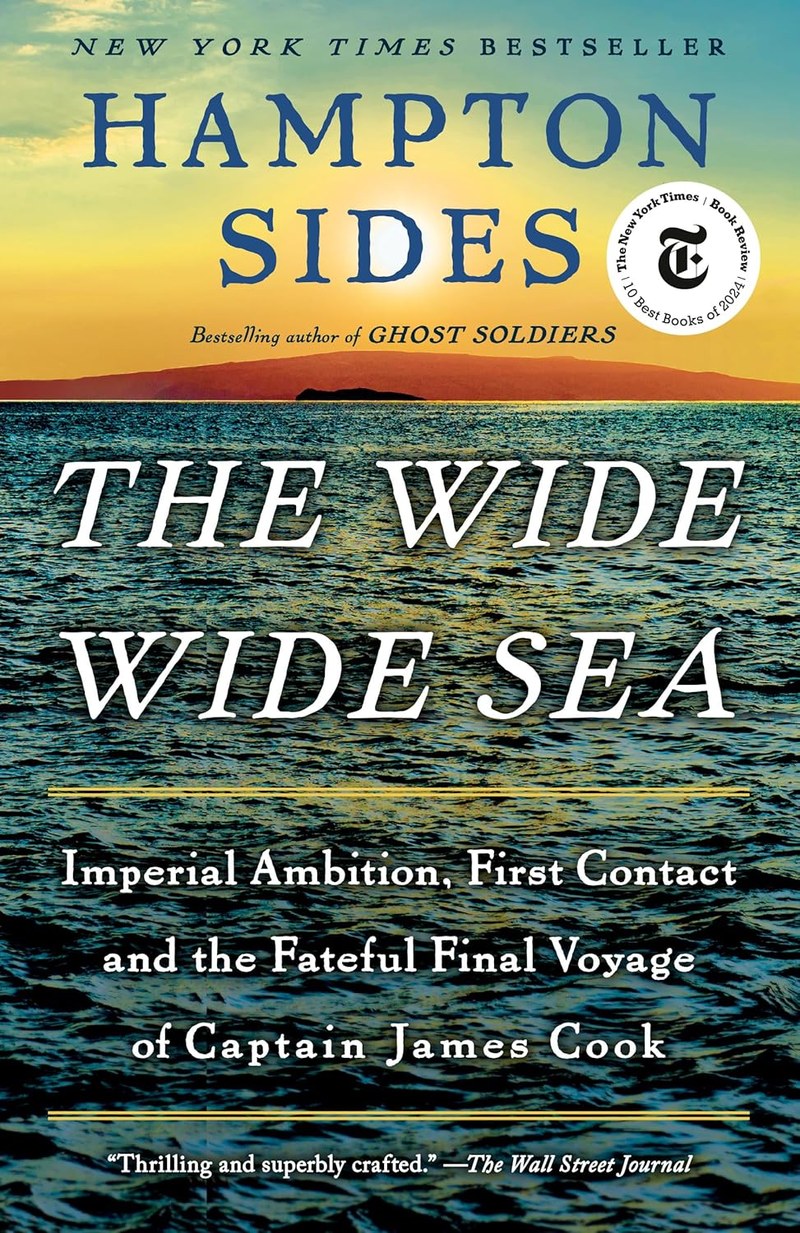
Captain Cook’s 3rd voyage is one of the great dramas of exploration and hubris. By 1776, Cook had already made a reputation as one of the finest explorers of his, or any age, combining exceptional skill at navigation and cartography with stern yet fairhanded leadership and surprising sensitivity to cultural norms. He could have accepted a generous retirement as one of the heads of the Greenwich naval hospital, but the lure of the sea was too much.
The ostensible reason for Cook’s third journey was to return Omai, a Polynesian, to his home. Omai had come to England with another expedition and charmed high society, but his time as a curiosity had reached its end and all were ready to see him home, newly armed with European weapons, to seek revenge on the warriors who had killed his father. Cook’s secret orders were to search for the fabled Northwest Passage from the western end. Contemporary theory held that ice could only form in fresh water, and that sea ice was the outflow from terrestrial rivers. Theoretically, far enough away from shore there would be open water.
The first part of the journey took him through Cape Town, the Kerguelen Islands, New Zealand, and then the Society Islands, where Cook delivered Omai and a host of animals sent by King George to the Tahitians. This part of the journey showed that something had changed in Cook. While life at sea requires discipline, Cook became for the first time a flogging captain, doling out 60 lashes for relatively minor offenses. Relations between Polynesians and the English were often characterized by theft, as Polynesians had a desperate desire for iron, a more relaxed attitude towards private property, and a tradition of heroic trickster-thieves, but Cook’s responses became increasingly disproportionate.
At first thieves had half their head shaved, humiliating in the body conscious islands but a mark which would fade after the English departed. At some point, Cook started cutting off the ears of native thieves. On Moorea, after the theft of a goat, Cook’s crew (and Omai) embarked on a rampage of destruction until the animal was returned.
After departing the Society Islands and heading north, Cook made the major discovery of the voyage, finding the Hawaiian islands. Though smack in the middle of the route taken by the Manila galleon for over a century, Europeans had somehow missed the islands. Cook landed on Kauai for a peaceful encounter before skipping the rest of the chain to head north. The exploration of the Pacific Northwest and the Alaskan coast again displayed Cook’s skills, as he turned Bering’s vague and misleading maps into precise fixtures of landmarks, made peaceful trades with local tribes, and skillfully navigated treacherous waters and ice. The Northwest Passage was blocked by the arctic icecap, an example of negative discovery, and Cook set sail south to winter in some place more hospitable.
This is where the story gets truly weird. Cook arrived at the big island of Hawai’i and chose to circle the island counter-clockwise. By an immense coincidence, this occurred at the same time as the festival of the god Lono, who was prophesied to return after circling the island counter-clockwise and whose holy symbols included a shield adorned with crosses and white streamers which resembled the sails of a ship. The Hawaiians took Cook to be the return of their god.
Or at least some people argue they did. We can’t really reconstruct the attitudes of people who lived centuries ago when we have incomplete oral histories. Cook’s journals for this period are missing, either never written or destroyed at some later point, though he was a conscientious diarist. Sides comes down with those who believe that Cook was sincerely treated as some sort of divine figure, an opinion I agree with. Hawaiians weren’t naive, but they were a profoundly spiritual people whose belief systems were flexible enough to extend to something like incarnation.
The extended stay of Cook and his crew wore out any friendly feelings between the two cultures, and when Cook departed in February, all were happy to move on. Except the Resolution’s foremast broke, and Cook returned for repairs. The season of Lono was over, and the god was supposed to be gone. It was now the season of war.
When one of the ship’s cutters was stolen, Cook attempted to take the King of Hawaiʻi, Kalaniʻōpuʻu, captive. Massively outnumbered, Cook refused to back down, and he had an untested faith in the psychological power of musketry to scatter the natives. According to Sides, Cook fired the first shot, killing a Hawaiian warrior. He and his men were then attacked from all sides and overwhelmed.
This is a fantastic history, showing some of the wonder of the era, and the tragedy of man eventually destroyed by his own mistakes and hubris.