
Traitor to His Class: The Privileged Life and Radical Presidency of Franklin Delano Roosevelt
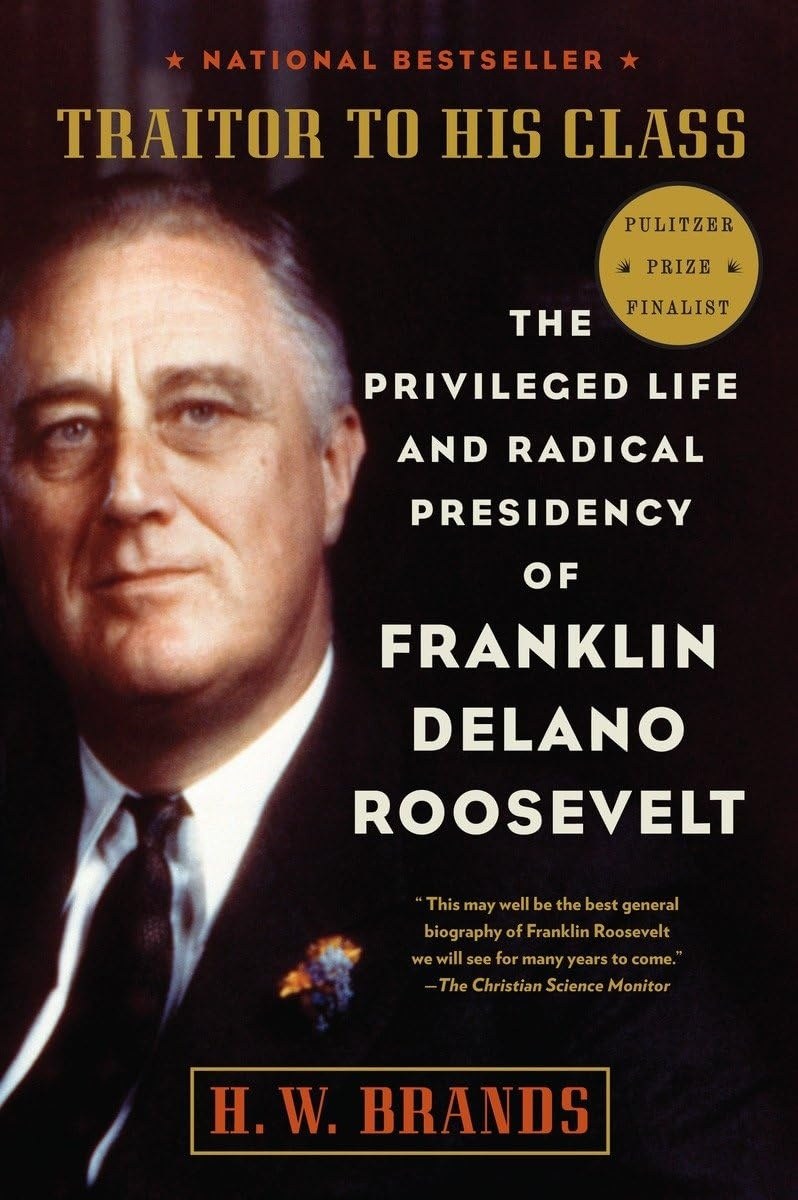
I know a lot about WW2, a little about the New Deal, and almost nothing about Franklin Delano Roosevelt, despite considering him one of the greatest American presidents. Brands’ comprehensive biography corrects that gap.
The throughline of the book is FDR’s good luck, with the exception of the polio which paralyzed him. FDR came from a privileged background, the only child of his overbearing mother Sara and much older father James. He was very much a Delano, a Democrat in the upper-class Republican society he swam in. He was educated at Groton and Harvard, and became an avid sailor. His natural charm and likeability let him sail through life.
The first major stroke of luck was the election of Woodrow Wilson in 1912. Republicans were the natural majority party in the late 19th and early 20th century, with the Democrats an uneasy alliance of Southern segregationists, urban ethnic machines like Tammany Hall, and Western populists. Teddy Roosevelt’s 3rd party run split the ticket, and Wilson slipped into office. FDR finagled an appointment as assistant navy secretary, a job which became much more important and interesting with the outbreak of World War I.
The polio which paralyzed him in 1921 proved a hidden blessing. He sat out the Republican dominated politics of the 1920s, which might have shortened his career. Time spent recuperating at Warm Springs in Georgia gave him a first-hand appreciation for rural poverty. A squeaker of an election in 1928 made him governor of New York, giving him executive experience. When the stock market crashed in 1929 and Hoover’s laissez-faire politics proved entirely incapable of stabilizing the economy, a ham sandwich could have been elected on the Democratic ticket in 1932.
Fortunately for America, Roosevelt was anything but inert. His was the first political 100 days, now a common measuring stick for new Presidents, the time between his inauguration and the summer Congressional recess. He passed a bevy of New Deal legislation, stabilizing the dollar and starting a variety of public relief projects and three letter agencies. The New Deal was a bold intervention into political economy, a statement that capitalist self-interest could become collective failure, and that a strong visible hand was necessary to achieve common good.
The actual record of the New Deal is mixed. The landmark National Industrial Recovery Act was overturned by the Supreme Court, and Roosevelt’s court-packing plan was his key political defeat. The economy sputtered again as New Deal measures were unwound, causing a second depression. For clear victories, Social Security has become a fundamental part of America.
Roosevelt was also a farsighted internationalist in a period of blinkered isolation, and did a solid job preparing America for World War 2 and then leading the Allies. This book focuses on grand strategy, and Roosevelt’s use of personal relationships to try and push for international idealism against Churchill’s imperialism and Stalin’s totalitarianism. For all its flaws, the UN succeeded where the League of Nations failed immediately, and both empires were substantially unwound by the end of the 20th century.
Roosevelt was increasingly lonely later in life. Emotional repression was the style of his background. He and Eleanor had drifted apart decades ago, their marriage now a matter of political convenience. Old friends like Harry Hopkins and Louis Howe had died. The power of the Presidency was too much to create new ones. Roosevelt died before the war was won.
A few things come clear as lessons. Roosevelt was a master of the press and popular outreach. His radio fireside chats were a novel advance in linking the President to the people. His weekly press conferences managed to keep DC reporters on his side, allowing for friendly coverage. He picked people who could get things done, and his style of managerial chaos seemed to succeed. The basic lessons: work the people, work the press, and damn the norms, are key lessons for Washington success. It’s a shame that only the worst people in the world remember them.