
Wolf Hall
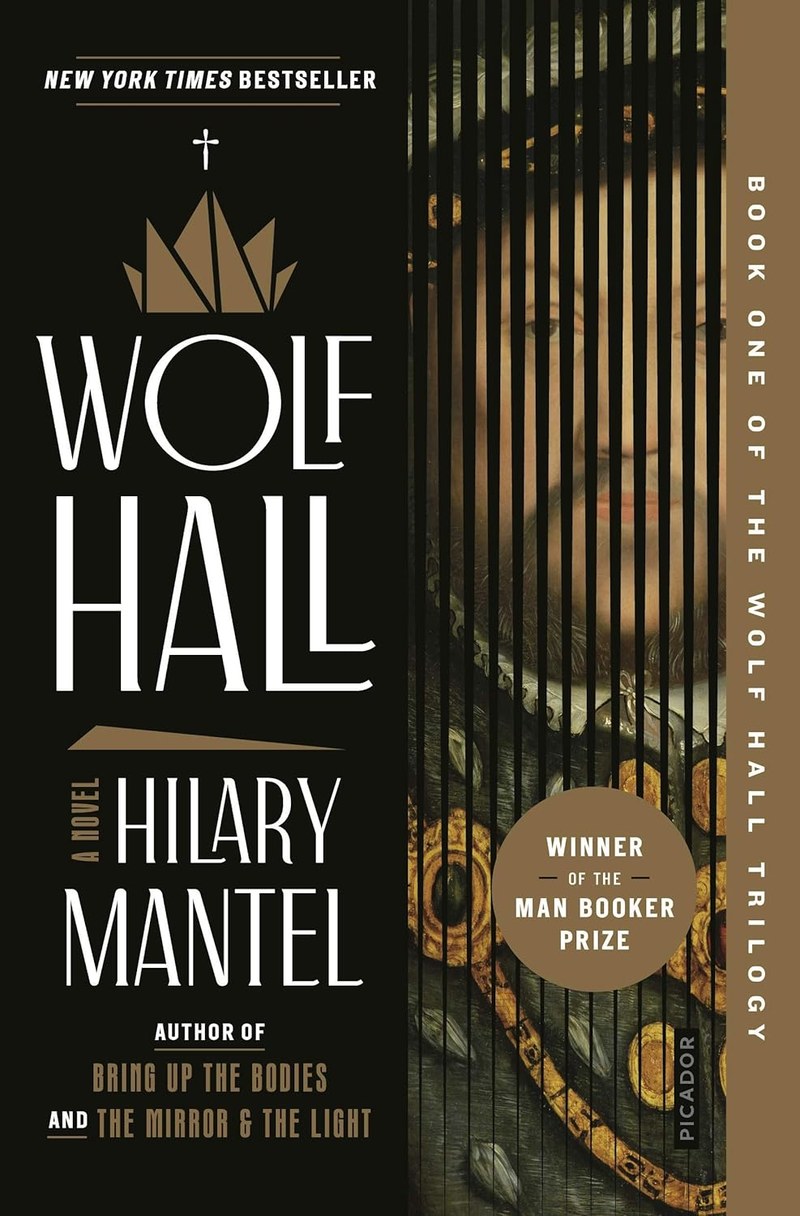
Wolf Hall is the first in a series of highly lauded historical novels centered around Thomas Cromwell, a key figure in the reign of King Henry VIII and the events of the English Reformation. As historical novels, the key events are bounded by the historical record, and common knowledge about Henry VIII is that there were a lot of wives and even more beheadings. Serious historical fiction is a kind of lie that attempts to find a higher truth. Wolf Hall is perhaps primarily a response to the play A Man for All Seasons, which casts Thomas Moore (of Utopia fame) as an idealistic martyr against Cromwell’s pragmatism. In this, it succeeds, although much of the credit rests on Slater’s reading, which gives Moore’s dialog an acidic sneer. As an attempt to find the spirit of another age, I am not quite sure that this book succeeds.
Cromwell is a fascinating figure, a self-made man in an era when blood really mattered. The book opens with Thomas getting the shit kicked out of him by his father at age 15, then skips forward several decades to Cromwell as a counselor to Cardinal Thomas Wolsey (read by Slater with a delightful flamboyance). In between, Cromwell has had quite a life, serving as a mercenary soldier for France in Italy, and learning several languages, finance, diplomacy, and law.
The opening of the book has Wolsey on the decline. The basic political issue in England is that Henry VIII is approaching 40, and Queen Catherine is over 40, and there is not yet a male heir. Henry would like to get rid of Catherine and marry Anne Boleyn. Except that the Catholic Church doesn’t recognize divorce, and as a Spanish princess and aunt of Holy Roman Emperor Charles V, casting her aside has Consequences. Catherine was previously married to Henry’s dead older brother Arthur, but that marriage was ruled as unconsecrated by a previous Pope. Getting all of that reversed so the king can get married and start having sons is a mess.
Wolsey has been working towards this, but not efficiently enough for the King, and is seeing his titles and lands stripped away. Cromwell survives the downfall of his master, and the death of his wife and two daughters from the mysterious sweating sickness, and then rises through the king’s court, ably making whatever the king desires possible. And if this involves shattering the Catholic Church, well, that’s collateral.
My issue with the book is that the key figures, Cromwell, Henry, Anne, fail to come into focus. Cromwell is able, yet without interiority, always working in service to others. He is striving to prove himself against his dead father, because success is his habit and failure is not, because he is obligated to his household, and because of the immense consequences of failure, but there is little sense of what he wants or who he is as anything other than a machine for schemes. Henry loves to hunt, to be king, but has little interest in the realities of rule rather than performance. Anne Boleyn is a mass of ambition and vengeance, who sees the throne as the best seat in the house to manipulate others according to her whims.
The political is always personal, to invert a cliche, and that is particularly true in a real monarchy, where blood and friendship tell more than positions in the bureaucracy. It is strange how much of history rests on one man’s desire for a son, and that one man’s choice of one woman. Mantel has a wonderful turn of phrase, observations on the exercise of power, or the passing of the seasons. Yet I don’t have a sense of the 16th century as a time and place different from my own.