
ADHD Nation: Children, Doctors, Big Pharma, and the Making of an American Epidemic
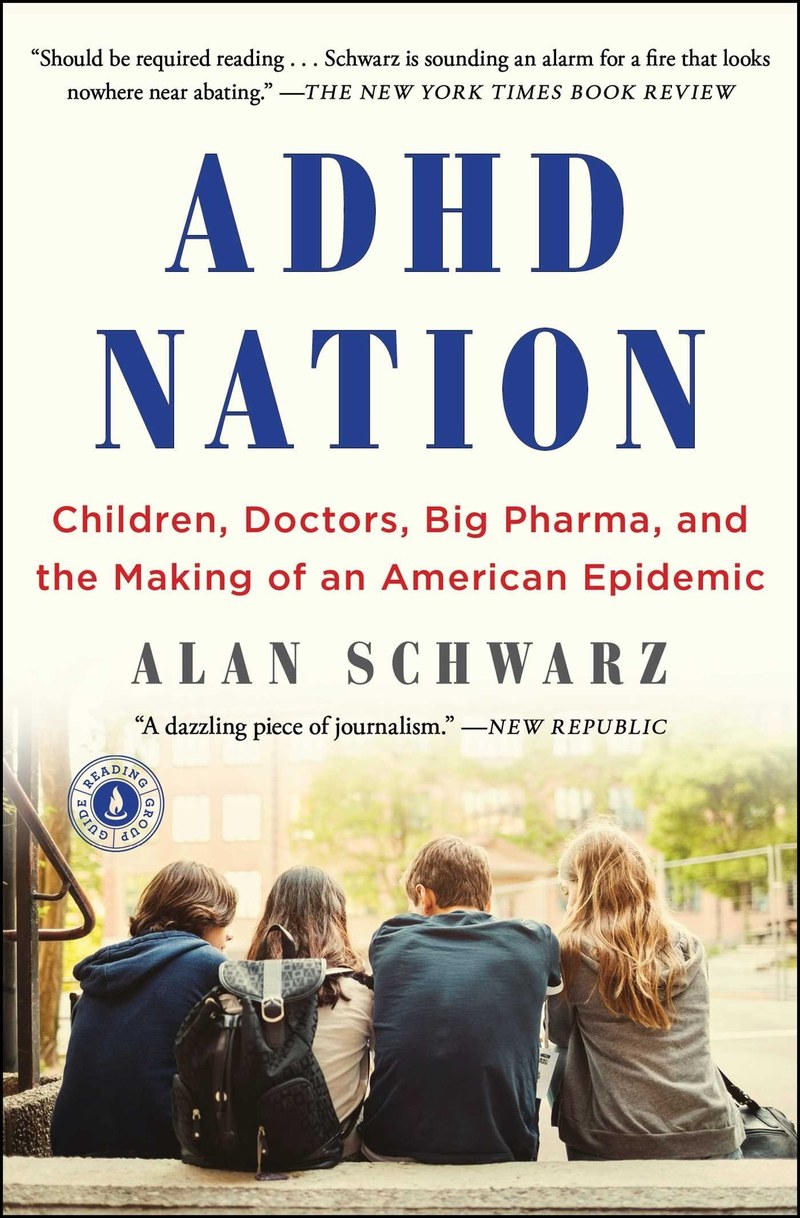
ADHD Nation is an important look at the history and widespread use of stimulant medication to treat ADHD. Schwarz delivers a detailed historical account, punching up what could be a rather dry narrative by focusing on the career of Dr. Keith Conners, an elderly childhood psychiatrist who was a key figure in popularizing the widely used Conners Scale for diagnosing ADHD and who has since turned against the disorder, and Jamison Monroe and Kristin Parber, two young adults whose diagnosis of ADHD served as an entry point to substance abuse problems, and who recovered to run a rehab center.
The story bounces across America, and from the 1930s onwards, but always returns to two main themes. First, the medications used to treat ADHD are potent stimulants which are frequently abused by patients seeking stronger highs. Second, ADHD itself is a product of Big Pharma, an artificial market created by barely-legal ploys involving hidden payments to influential doctors, consumer advertising that bypasses FDA regulations by not mentioning drug names, and scientific malpractice via poorly designed studies.
I literally wrote my dissertation on this topic, and on the one hand, Schwarz isn’t wrong on any factual particular. He’s right to target “ADHD is both under-diagnosed and over-diagnosed” as a meaningless cliche, and his expose of the very fragmentary system whereby serious stimulants can be prescribed indefinitely on the basis of a five minute interview, is welcome.w. On the other hand, he’s not an academic, and that means that he lacks a strong idea of how medical research should be done, or what counts as trustworthy information about psychiatry for the public. The focus on a handful of very serious cases of drug abuse obscures whether an initial prescription of stimulants led to ongoing problems (post hoc ergo propter hoc), or the systematic effects on millions of kids who are neither ADHD wrecks, nor stimulated into amphetamine psychosis. A similar focus on ADHD purely as a product of marketing ignores the fact that it fits into a very real hole in our society, an anxiety about merit and competition and fairness that would exist with or without the drugs.
A good book, and one which I wish had come out a few years earlier, so I could have included it in my diss, but not the last word on ADHD.