
Between the Strokes of Night
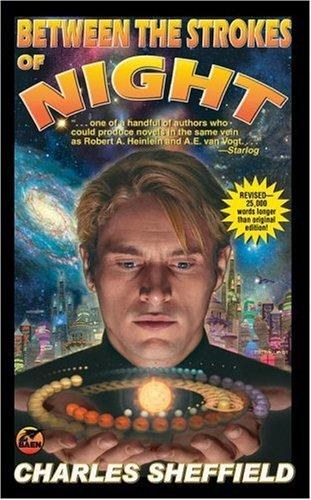
Between the Strokes of Night is a hard science-fiction novel caught between the grandiosity of deep time and associated big ideas, some standard medium-clunky characterization typical of the genre, and a plot that feels entirely tertiary to the ideas.
The first part of the book is set in the near-future of the 2010s. Earth is suffering under climate change and political instability. An enigmatic super-billionaire and space industrialist recruits the sleep-research team led by Judith Niles, with the goal of cracking suspended animation. The scientific team just manages to make the transfer to the orbital habs when someone decides to try a nuclear first strike and the waves of counterstrikes obliterate civilization, leaving just a few tens of thousands of people in what are fortunately more-or-less self-sustaining habitats to figure out what to do next.
Smash cut nearly 30000 years in the future, and we’re with Peron, a 20 year old who’s participating in the Planetfest contest, a series of grueling endurance contests that’ll whittle down thousands of finalists to a top 25 who get an elite status. He and some of the other competitors figure out that there’s something weird going on with the space-faring Immortals who influence their society from behind the scenes, and when Peron is injured in one of the contests, he’s whisked away on an Immortal starship to find out.
All of this is windup to the core tech of the book. S-space, which the immortals use, isn’t some kind of hyperspace FTL physics tech. Rather, it’s a form of suspended animation that has people living at a roughly 2000 : 1 time dilation, such that a single normal year passes in a little over 4 days. The Immortals are the sleep researchers from Part I, working through the social and astronomical problems of deep time, which involve communicating with extra-galactic intelligences that seem to operate at even slower timescales. S-space has some advantages, you don’t need to sleep and you age ever more slowly than subjective time would expect. Normal space robotics provide the illusion of instantaneous meals and local teleportation. The explored downsides are hair loss and infertility. Unexplored is the problem that you’re still physically in N-space, and if something goes wrong, like explosive decompression, it’ll be over far before you can meaningfully react to it.
The pressing problem facing S-space society is that some other uncontacted alien species is doing stellar engineering, and in a few hundred thousand years every star in Sol’s neighborhood is going to be a red dwarf. Peron and his friends make a radical suggestion, that they lead a cohort to abandon S-space and do research in real time, providing a roughly 2000x effective research speedup. This is something the S-space geniuses missed entirely, the obvious flipside of their slowed down lifespans.
We don’t hear if there’s a solution, though the end has another deep-time being witnessing The Big Crunch as the universe ends.
What’s good is the depiction of scientists as both brilliant and human (Sheffield had a scientific background himself), and people are horny in a way that’s refreshing, between the “obviously author’s fetishes” of the era and the chastity of the present. S-space is an interesting idea, and the game of figuring it out is well-done, though Sheffield misses some obvious extensions to his theory. The plot, three totally disconnected chunks, could use some work. But hey, if you like classic scifi, this is an overlooked gem.