
Black May: The Epic Story of the Allies' Defeat of the German U-Boats in May 1943
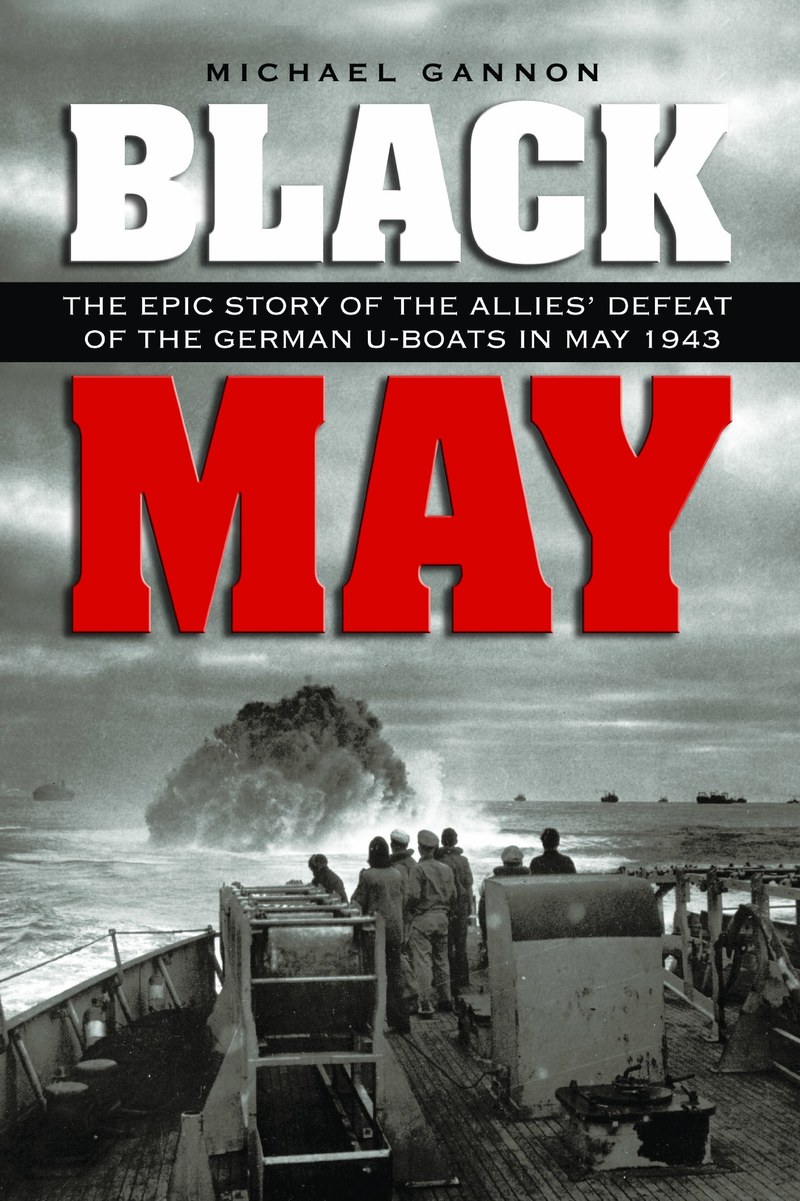
Black May is a serious, if somewhat scattered account of the crucial finale of the Battle of the Atlantic in May 1943. Gannon was a real historian, and this book draws heavily on primary sources like the logs of vessels involved and interviews with surviving captains, and uses the techniques of statistical analysis to show that even before May 1943, the U-boat was on the decline. The narrative and analytic aspects of the book never quite gel, leaving an unfair impression of amateurism.
The crucial moment was the battle of convoy ONS 5. In early May, 43 merchant ships returning from Britain to North America, and escorted by 16 Allied warships, faced off against several wolfpacks containing 43 U-boats over the course of a week. During the week-long battle in awful weather, 13 Allied ships and 6 U-boats were sunk. ONS 5 paid a high price by any standard, but it was the last time. Two later convoys in May were defended with no losses, and after, Donitz withdrew the U-boat arm from convoy action, making pinprick attacks at ships sailing independently in distant oceans. Britain’s material security was ensured, and resources flowed from overseas to the fronts, leading eventually to the collapse of Nazi Germany. Though unheralded and fought over trackless ocean, the Battle of ONS 5 was as decisive as Trafalgar or Tsushima.
The role of technology is hard to overstate, and this book punctures several myths. The key technology on the Allied side was HF/DF, radio direction finding, which alerted convoys to the chattering wolfpacks. The U-boat staff considered it impossible that HF/DF equipment could be made small enough to mount on a destroyer or similar boat. Contrary to the popular image of Bletchley Park, during this period the Enigma was not broken, and even when it was the delays in decryption meant that the information was of little tactical importance. Conversely, the Nazis had broken the Anglo-American Naval Cipher No 3, and had inside knowledge of convoy routing. Neither side’s cryptographic establishment seriously considered that their own codes were insecure.
Allied weapons in 1943 were also gaining a comprehensive superiority. The combination of 10cm radar and the Leigh light allowed for aerial night attacks, taking away a key refuge for U-boats recharging their batteries and moving into attack position on the surface. The hedgehog mine projector, though difficult to use, fired impact-fused charges that would destroy a U-boat with a direct hit. Depth charges, which exploded at a set depth, were surprisingly inefficient at killing the tough little U-boats. Though in a tactical sense, a U-boat forced away from a convoy was a victory, and a damaged boat that had to retreat and be repaired was an operational victory. More novel weapons like homing torpedoes and aerial rockets, cemented Allied technological superiority. The U-boat arm introduced their own tricks, including new types of torpedoes that would swerve though a convoy, and the potentially transformative Type XXI “electroboat” in 1945, but it was too little too late. It took a shocking 6 months to develop an effective radar warning receiver for the 10cm radar, and unlike American submarines in the Pacific, U-boats were never equipped with their own radars and so fought at a disadvantage in the often foggy North Atlantic.
And simple weight of numbers bore it out. Once the Liberty Ship program got started, U-boats simply couldn’t sink merchantmen fast enough to destroy the Allied fleet. New escort ships, corvettes, frigates, escort carriers, and destroyer escorts, were quick to build and while they lacked the speed to keep up with the battle fleet, they were more than capable of defeating U-boats. The inefficient Nazi industrial machine simply couldn’t keep up, aside from the immense fortified U-boat pens along the Atlantic coast, which protected docked U-boats from bombing.
The last aspect of the battle is the human. Both sides fought magnificently. Allied merchant mariners suffered the highest proportional losses of any branch on the Allied side. The U-boat arm suffered the highest proportional losses, period (even being a Kamikaze pilot was more survivable), and yet they continued to sortie. However, the Allies developed effective defensive tactics based around teamwork and aided by the statistical techniques of operational research. Donitz fought his war by remote control, and this effort was a failure. Massive wolfpacks like the ones that savaged ONS 5 allowed other convoys to cross without contact. The constant radio traffic enabled Allied HF/DF and decryption efforts. And despite the concentration of force, U-boats never seemed to attack in large numbers. It took several escorts to fend off a single U-boat, so in theory a dozen or so U-boats attacking simultaneously from all directions would overwhelm the escorts and sink much of the convoy. Yet despite Donitz’s control, this simply didn’t happen.
There are plenty of interesting nuggets in Black May, but I can’t recommend this book to anyone but naval warfare buffs with several other Battle of the Atlantic books on their shelves.