
Children of Strife
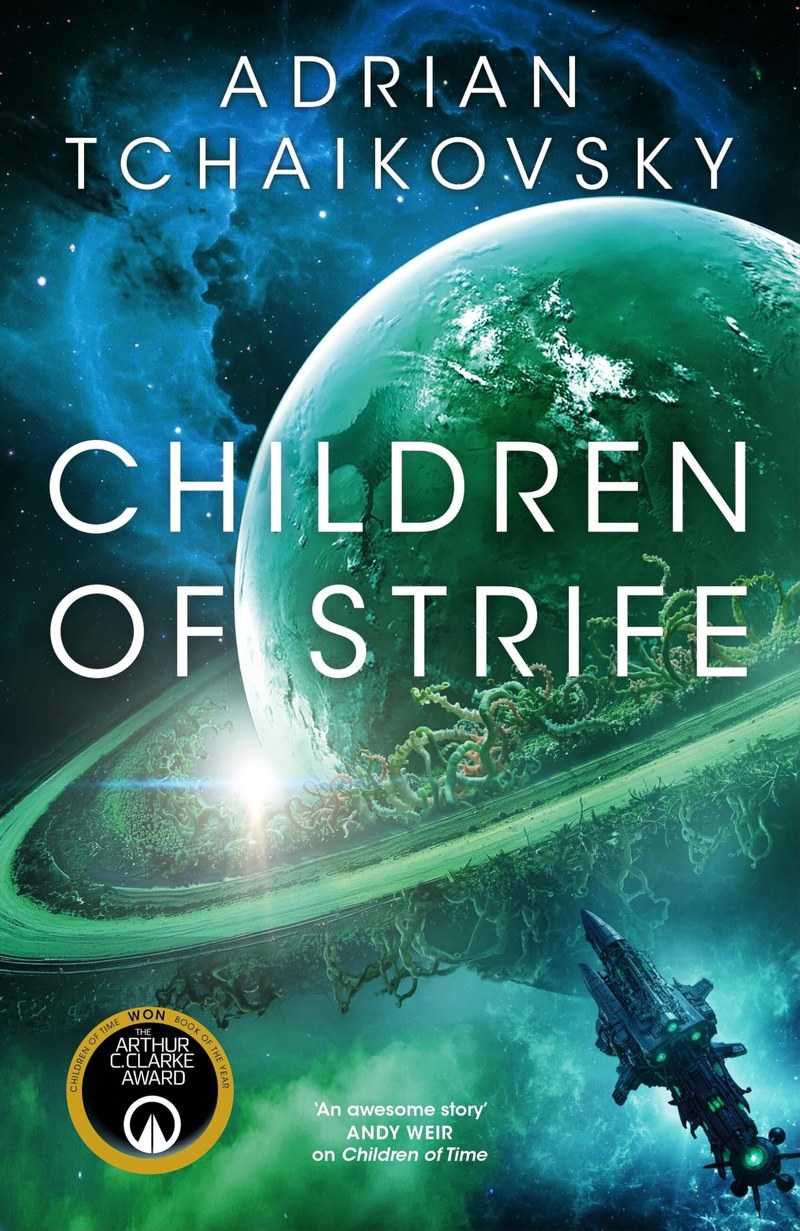
Children of Strife continues and expands on everything that’s great about this series: new modes of cognition from non-vertebrates, the arrogance of terraformers, desperate survival against the harsh environments of space, and the meeting of minds.
The first major threads follow a group of five self-exiled industrial tycoons, “geniuses” whose criminal activities had them flee Earth under the dubious leadership of Gerey Hartmann, a self-important aspiring god (any resemblance to a living titan of industry is entirely coincidental). An implacable enemy of Arvrana Kern, Hartmann and his colleagues are seen through the eyes of Redina Kott, who at least has a sense of humor to liven up her corporate sociopathy. Their renegade terraforming operation is proceeding abysmally, constantly overwhelmed by literal bugs, when the great silence virus knocks out their station. Guided by Ken Pil, an acid-burnt longevity scientist, the five manage to figure out how to upload themselves into the ecosystem as distributed minds, entering a constant hell of war.
Meanwhile, thousands of years later, a group of dissenters from the panspecific coalition stumble upon Hartmann’s world, which has become a verdant planet complete with biological space elevator. The mission is led by Cato, an uplifted mantis shrimp, and includes Alis, a mentally damaged member of the Ymir expedition, a branch of the Nod organism, two portiids who are conducting taboo research into the nature of mind-uploading that created Avrana Kern, and a Kern fragment that has diverged from the main branch. When half the expedition goes offline, Cato, Alis, and Kern have to resolve the mystery of the implacably hostile Life on the planet below, and find a balance between the arkship survivors, the aggressively assimilative swarm that the Nod organism can be, and the half-insane minds of Gerey and his colleagues.
The five tech titans in the first thread slightly overstay their welcome; I spend enough time dealing with this particular flavor of asshole in real life to not enjoy it in speculative fiction. Cato, the uplifted mantis shrimp, is perhaps the best example of the honor warrior alien in science fiction. There are very clear reasons why a species that can punch hard enough to create sonic booms would default to ‘might makes right’, and a complex hierarchy of dominance that defines who gets punched. But more than that, Cato is a warrior poet, declaiming his opinions in short stanzas that contain just a bit of the subtle meaning that a sign language designed for dozens of rainbow-shimmering limbs can express.
Children of Memory was a dip, as simulated worlds are not very satisfying, but Strife is right back to form.