
Edge City: Life on the New Frontier (Anchor Books)
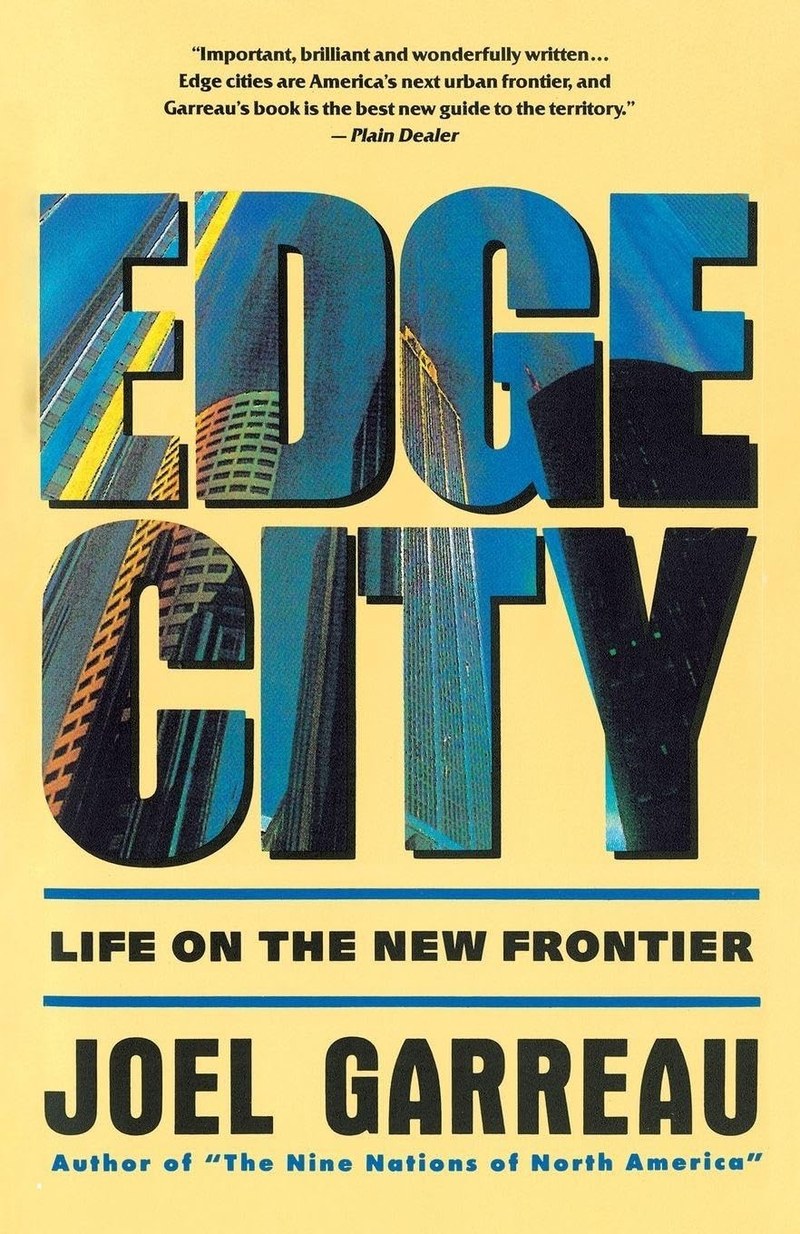
Edge City is a circa-1990 study of a new pattern of urbanism, one which has become so common-place as to be utterly unremarkable. Garreau’s Edge City has 5 million square feet of office space, commensurate retail, a population that increases during the working day, and didn’t substantially exist 30 years ago. For better or worse, Edge Cities are the only places in the Western world that have seen substantial economic and population growth, from Irving CA to Alexandria VA, 287 & 95 New Jersey to the Houston Galleria.
Edge Cities are driven by economic and social factors. Increasingly computerized white collar jobs can be supported more cheaply outside of traditional downtown centers. Ordinary people won’t commute more than 45 minutes, and won’t walk more than 300 feet. Executives want to be no more than 8 miles from their office, an airport supporting executive jets, and their polo stables. Women workers prioritize the feeling of safety, and hate public transit.
Edge Cities are developer driven masterplanned dreams, or alternatively Ballardian nightmares of empty souls. An Edge City mixes the economic imperative to minimize costs with the need to convey an appearance of professional luxury that manifests in a “premium mediocre” glossy corporate aesthetic. Edge cities are immensely car dependent, and incapable of growing dense enough to support either public transit or walking. There are no public places, with malls and campus greenspaces offering a loose facsimile of public life.
Garreau writes enthusiastically about the trends that he sees, while also capturing the chillingly dystopian aspects. The section on “Shadow Governments”, the array of coordinating committees that fill in the gaps where public bodies fail, centered around Phoenix, is perhaps most evocative. The Salt River Project, a water utility, has immense powers in the region. Homeowners Associations can levy punitive fines on people who commit violations like “parking your RV in the driveway”. The Sun Valley Posse, a group of retirees with Glocks cosplaying as police officers, hits very differently in 2025.
Edge Cities lack the direct Jim Crow dynamics of older suburbs, with the chapter on Atlanta discussing the rise of a Black middle class. Conversely, they are incredibly class conscious, with microscopic distinctions between executives, senior managers, white collar grunts, and blue collar service and infrastructure workers. There’s no room for the uneconomic in Edge Cities; artists, madmen, or unpaid caregivers.
Garreau’s gleeful boosterism can be wearying, but as someone who reads a lot of vintage futurism, Garreau got a lot right and little wrong. I just wish that there were some alternative to this mode of life.