
Going After Cacciato
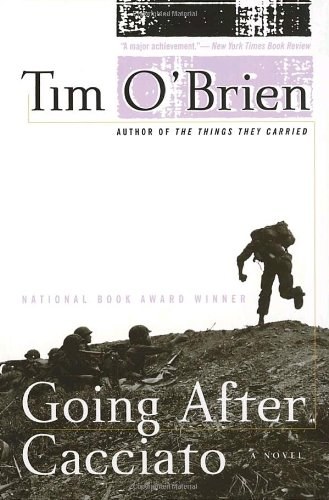
Going After Cacciato is where it all began. I remember reading it in 11th grade in AP English and enjoying the book but not getting it all all. Cacciato is non-linear, fragmented, unreliable, a gorgeous meditation on possibility.
Paul Berlin is a reluctant soldier, an ordinary young man drafted into a war he does not understand and merely wants to survive. He’s surrounded by hostile land, alien comrades at arms, the constant specter of death. For all that Berlin is an outsider, literally the last man in the column. Cacciato is even more so; an undefined moonfaced kid snapping bubblegum and whistling on night ambush. Cacciato doesn’t seem to understand that he’s at war, and at some point he decides he isn’t. He’s going to walk to Paris, 8600 miles across Eurasia. Third squad, with Paul Berlin among them, gives chase.
It’s all impossible of course, and the story unfolds in alternating sequences of the journey and Berlin on watch at night, in a tower above a beach, daydreaming about how the chase could have gone. The book shines in the secondary characters: the philosophical Doc Peret, the commanding Oscar Johnson, Stink Harris, the worn-down old Lieutenant, and Berlin’s dead and the way they died. Some of the individual scenes are iconic, fantastic, insane: Doc Peret feeding M&Ms to a critically wounded man because there’s nothing to be done; Falling into a labyrinthian Viet Cong tunnel complex; running afoul of the SAVAK in Tehran.
However, the overtly fantastical elements run counter to some idea of realism, and Berlin is a nullity as a main character. For what it’s worth, I greatly prefer The Things They Carried.