
His Majesty's Airship: The Life and Tragic Death of the World's Largest Flying Machine
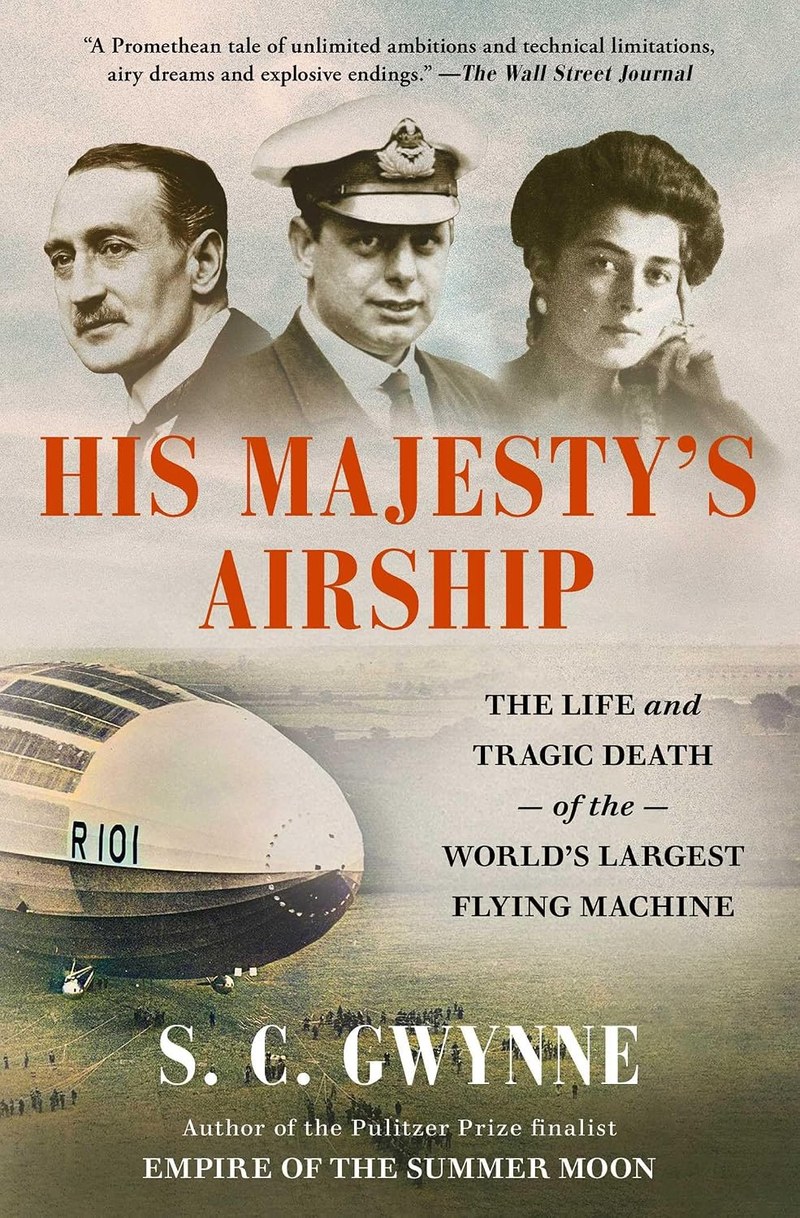
There is something in us that thrills to the idea of airships: the vast cigar shape, the elegant flow, the apparent solidity of the object in space. Even now, in 2026 with jet travel firmly perfected, I’d still always pause to look up when Pathfinder 1 left its hangar at Moffett Field or the training blimp made low circles over my office park. And for all that they tug at our heart-strings, airships are a profoundly bad engineering idea.
Gwynne focuses this book on the creation and destruction of R101, a pioneering British airship wrecked on its first real flight. This story also has a lot to say about the importance of an engineering safety culture, and how rigid airships are a bad idea from start to finish.
Rigid airships, or Zeppelins after the eccentric German nobleman who created them, are a few years older than airplanes. Comparing a circa 1910 airship and airplane, which one would win out is very much in doubt. Airplanes of the era were little more than powered kites, with short ranges and noisy and freezing conditions. They could carry a pilot and either one other person or a few hundred pounds of payload. Zeppelins could carry a few dozen people, and while slower than airplanes could stay airborne for days.
It took the first World War to separate the two technologies. A late war patrol plane was a lethal fighting machine that could literally fly circles around 1914 era planes. Zeppelins were the tool of a German strategic bombing campaign, which saw hundreds of cutting-edge ultra-lightweight height climbers developed. The strategic impact of the Zeppelin campaign was nil: a few hundred civilians killed, no industries disrupted, and most of the Zeppelins lost due to British defenses or accidents. The surviving Zeppelins were seized by the Allies as war reparations and mostly promptly wrecked by their inexperienced crews. The German airship industry was sharply curtailed.
In this environment, Christopher Birdwood Thomson, 1st Baron Thomson, a British Army officer turned Labour politician, developed a scheme to use airships to tie the globe-spanning British Empire together. An airship service could cut weeks off long sea voyages between England, India, Australia, Canada, and South Africa. He envisioned a network of high-tech airships linking strategic centers. Thomson’s policies led to the creation of the Vickers R100, and the ‘Socialist’ R101, which would demonstrate the power of his Labour/Imperialist ideology.
As it happened, the implementation was a disaster. R101 used numerous untested technologies, like diesel engines, novel hydrogen vents, and a pre-doped fabric cover, as well as creature comforts like an asbestos-lined smoking lounge. As built, R101 was severely overweight and suffered from major flaws in the cover and chafing on the gasbags which kept the hydrogen in. Competition between the R101 and R100 teams divided the expertise of the small British airship engineering community. Project Manager Reginald Colmore was most capable of managing up, and suppressed much of the bad news, leaving Thomson in the dark about the state of his airship.
As the date of the first operational flight approached on October 4, 1930, R101 was in no way ready. Thomson had notable personal reasons for making an attempt. He had to leave on the 4th to fly to India and be back in time for the British Imperial Conference. If he succeeded, he’d be promoted to Viceroy of India, supreme ruler of millions of people and one of the key posts of the empire. This would finally allow him to take his relationship with the beautiful Romanian-French writer Princess Marthe Bibesco to the next level. Bibesco was never going to leave her husband, but such an esteemed post would elevate Thomson to the first of her paramours.
Finally, the command structure of R101 was extremely confused. In practical command of the flight was Major George Herbert “Press On” Scott, a World War 1 airship pilot and the hero of the extremely risky transatlantic crossing of R34. Though Scott was a hero, he had also developed a hefty drinking problem and had been involved in several previous airship mishaps. His commands would run through Lieutenant Herbert Irwin, the nominal captain. Scott had demonstrated poor judgment and reckless behavior, and he boarded R101 already drunk.
Gwynne weaves the flight and background together, and I’ve unwoven them here, since there’s really not much to write about the final flight. R101 took off into stormy skies, crossed the English Channel against punishing headwinds, and then shortly after 2:00 AM, southeast of Beauvais, impacted the ground and burst into flame. There were six survivors out of the 54 souls onboard. Thomson, Colmore, and Scott were among the dead, along with numerous officers and designers.
The inquiry that followed was lackluster, a coverup unwilling to dig into the choices of men who had all died in the crash. The official inquiry concluded that the forward cover had failed, storm-water had reached the fragile gasbags (made out of cow’s stomachs as the most hydrogen impervious material available in the 1920s), and the nose-heavy R101 had collided with the ground. There were many sources of sparks that could have triggered the fire. Gwynne mostly agrees with the official account, and also notes that simulations and the state of the control surfaces show that along with the cover failure, the elevators had also broken moments before the crash. Simply put, it was a wonder R101 even made it to France.
R101 killed British interest in airships. The loss of the USS Akron and then USS Macon terminated the American program. The German airship service lingered on a few more years, until the more famous crash of the Hindenburg, and that was it for airships. His Majesty’s Airship ably combines the technical and personal to produce a non-fiction tragedy of the first rank.