
McNamara at War: A New History
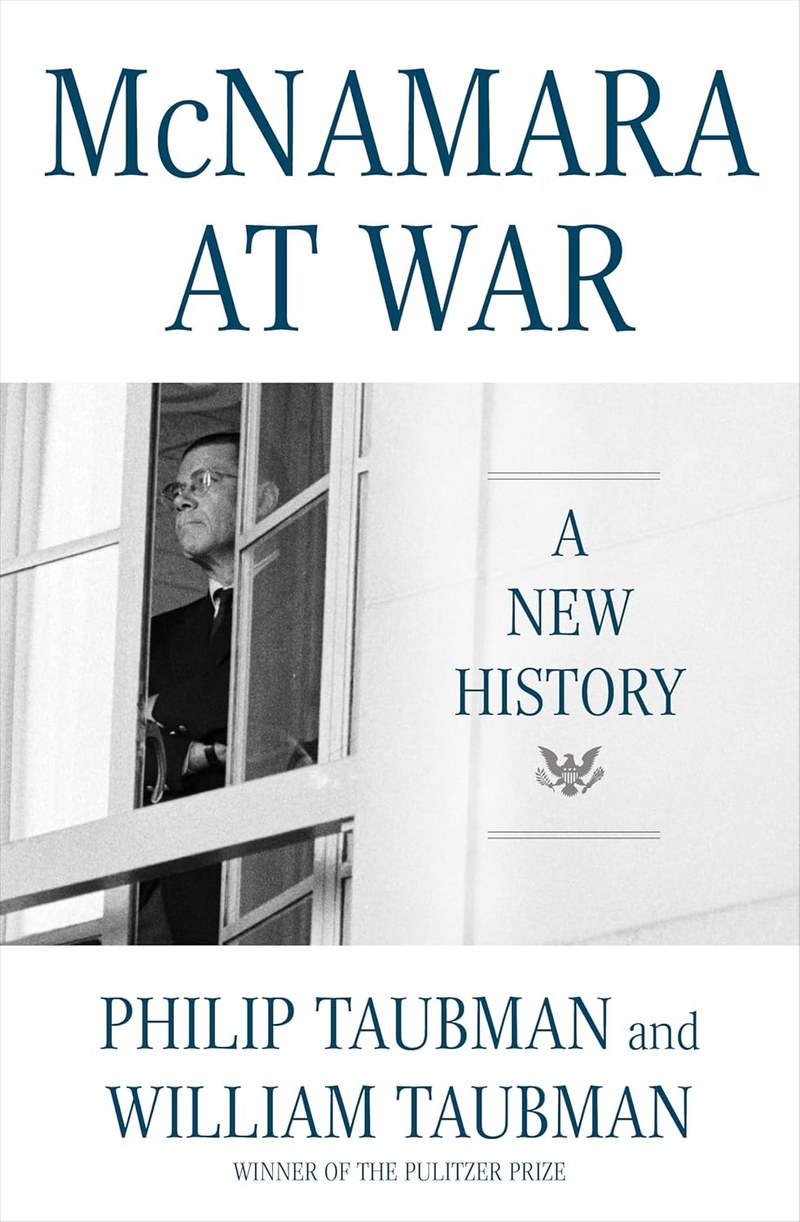
I’ve called myself a McNamara stan elsewhere so when a new biography arrived this year, I had to get it. I’ve read most of the major McNamara scholarship, with the exception of Shapley’s The Promise and the Power (1993), and I can say that this is a fine history that does a great deal to put McNamara in perspective, showing his strengths, failures, and surprising passions in poetry and romance.
The book is divided into three parts: before the war, the Vietnam War, and after the war. The young McNamara is a fascinating figure. His father was a successful shoe salesman, yet distant from his family. His mother was emotional and over-involved to a fault. The middle-class McNamara family lived in Oakland near enough to Piedmont to send the kids to the truly excellent and elite high school there. McNamara was a straight arrow, a literal Eagle Scout, and yet a popular and charismatic young man destined for greatness.
His early life was one triumph after another: college at Berkeley, becoming the youngest professor at the Harvard Business School, statistical service with the Air Force in World War 2, where he conducted the analysis showing low-level firebombing would be the most destructive tactic against Japan, and finally the Ford motor company. Through this period he pioneered his mastery of control accounting and quantitative metrics and also got married and had three children.
In 1960, he was tapped by the incoming Kennedy administration as Secretary of Defense. He rapidly became a key member of the administration, finding a strong working relationship with JFK and RFK, and forging a deep relationship with Jackie Kennedy. Despite some initial missteps, including the Bay of Pigs fiasco and a major gaffe on the missile gap (dramatically in favor towards the US, contrary to the Kennedy campaign’s rhetoric), he became a central player in the administration, helping to guide the world through the Cuban Missile Crisis.
This confidence would come back to haunt McNamara in Vietnam. The 60s saw a steady escalation of American involvement: More equipment, more advisors, a coup, air strikes against North Vietnam, troops to protect the airbases, and then a full-scale occupation of 500,000+ soldiers and Marines. McNamara assumed public responsibility for the war, confidently speaking on the progress being made to Congress and the public.
Yet privately, he had turned against the war sometime in 1965, shortly after the introduction of American ground troops. Even as protests raged across America, McNamara worked as Johnson’s attack dog, crushing dissent over the course of the war with an avalanche of statistics. He finally was fired as Secretary of Defense in 1968, becoming head of the World Bank.
At the World Bank, McNamara energized the sedate organization into a force for international development, embarking on repeated whirlwind tours of the world. He retired from that job in 1981, shortly after his wife Marge died of stomach cancer, a disease which he believed the stress of the war had contributed to.
In his later life he hiked, skied, dated various glamorous socialites and married one. He also began to speak out against his own conduct as Secretary of Defense. In Retrospect and The Fog of War show a thoughtful man, one tormented by his role in history.
For those directly affected by the Vietnam War, no atonement will likely ever be enough. Henry Kissinger mocked McNamara’s emotional outbursts in an interview later in life. This book presents a sincere attempt to reckon with McNamara’s mistakes. In particular, he saw himself as a de-escalating force in the Pentagon, which contrasted against the Joint Chiefs of Staff. Refusing to swerve from his values of loyalty and knowledge of the importance of unity of command in war, he critically failed to apply his talents in the greatest test of his life. His silence after leaving the Johnson administration, when his voice could have made a difference in events, was an act of profound moral cowardice.
Perhaps the best line in the book comes towards the end, after a 2002 conference in Havana on the 40th anniversary of the Cuban Missile Crisis. Castro invited McNamara to return in ten years, to which McNamara replied “In 2012 I will not be in Havana. I will be in hell.” and left the room.