
Misbehaving: The Making of Behavioral Economics
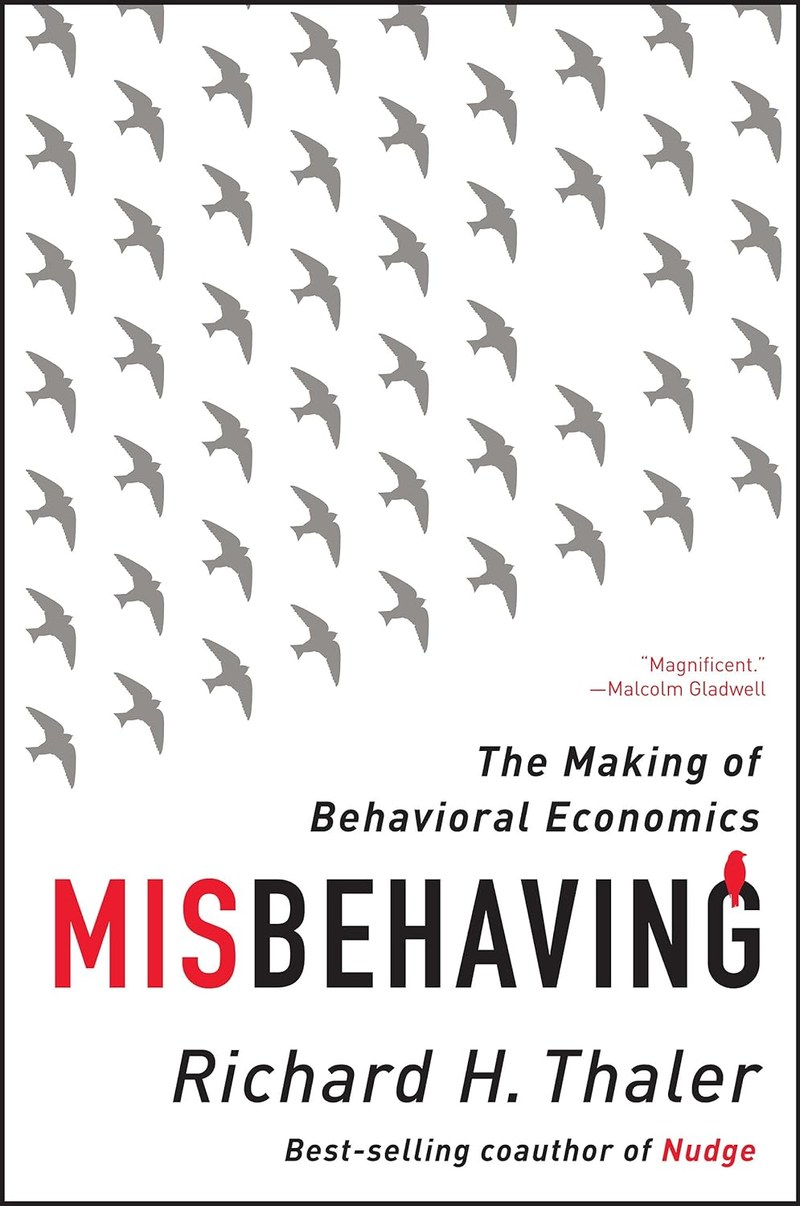
Misbehaving is a charming journey through behavioral economics, as told by one of its founding fathers recounting his academic career. Thaler co-authored Nudge with Cass Sunstein, and worked closely with Daniel Kahneman (Thinking Fast and Slow, Nobel Prize) and Amos Tversky. Thaler has a charming modesty given his esteemed company. His own Nobel came after this book was published.
The basic premise of behavioral economics is that economic theory is perfect—when applied to non-existent beings Thaler deems Econs who are perfectly rational. Real Humans make decisions based on a host of supposedly irrelevant factors (SIFs), which cause divergence from the predictions of economic theory. Through subtle experiments and data analysis, behavioral economics can find these anomalies.
Loss aversion is one of the major supposedly irrational factors. We tend to want to hold on to what we want, as demonstrated in a rather elegant experiment that compared trading rates in a group of students between tokens which could be redeemed for money and coffee mugs. No one has an emotional attachment to tokens, and so trading was close to rational. But people value a university branded coffee mug ($5 at the campus bookstore) even if it was randomly given to them, and are loath to trade.
Loss aversion shows up in the “irrational” attachment of wine collectors to their bottles over cash, sunk costs of attending events that are already paid for, and riskier behavior in people who are ahead and see themselves as gambling with the house’s money, or are behind and looking for any chance to end the day without a net loss.
Another SIF comes from discount rates. A hamburger today is worth more than one tomorrow. An Econ discounts at a consistent exponential rate, while Humans have a variable rate, for example 10% next year, 30% two years from now, 50% for everything past that, and varying discount rates create unexpected patterns of behavior where preferences can change.
Even supposedly objective experts, like investment fund managers are vulnerable to SIFs. Thaler and his collaborators found cases where the exact same stock traded at nonsensical prices, like an effective negative number, or with trivially available arbitrage. While this may seem like free money, the market can remain irrational longer than you can remain solvent, and some arbitrage traders have gone broke. The best investment advice is to not look at your portfolio too often, about once a year is proper, and do value investing on stocks whose low price-earnings ratio indicate an eventual reversion to the mean.
Finally, nudges can have public policy benefits, in what Thaler deems “libertarian paternalism”, where default choices are also good choices. Humans are lazy, unlike Econs, and will save more in retirement plans or be organ donors if those programs are opt out rather than opt in. No one’s choices are being infringed, but better defaults create better publics.
For a dry topic, Thaler writes with humor and joy, gleefully explaining how a student who “didn’t show much promise” helped to invent a new field and won the highest awards in his field.