
PAVN: People's Army of Vietnam
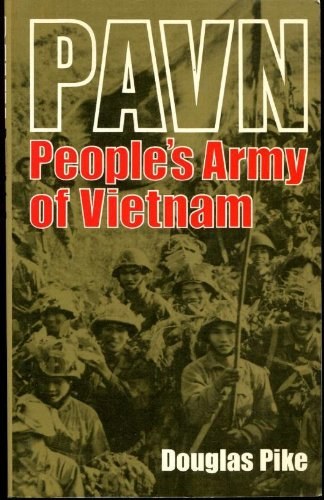
At the time this book was written in 1986, the People’s Army of Vietnam was the third largest army in the world, behind the USSR and China. The victory over the United States and South Vietnam was a decade in the past, and at the moment Vietnam was engaged in a border conflict with China and a quagmire of a counter-insurgency in Cambodia against the Khmer Rouge. Pike’s systematic study of PAVN is limited by the sourcing of the era, but for that, he does a fantastic job. Pike served as a foreign service officer in Vietnam in the 1960s and was one of the foremost scholars on Communist Vietnam. While he couldn’t exactly go digging around in the Hanoi archives to write this book, he read everything in the Vietnamese military journals and synthesized his conclusions.
For most Vietnam War scholars, a key question is “why did the Communists win?”. Pike ably explains the strategic doctrines of military and political dau tranh, which literally translates as ‘to struggle’, but carries overtones of “destiny” rather than “flailing” in Vietnamese. The military and political programs are intimately tied together, linked by close and intensive organization. There is a clarity of purpose that aligns the entire war. Every single soldier understands that PAVN is fighting for a unified and liberated Vietnam, free of colonial and capitalist oppressors. This understanding is often shallow, slogan-level, but it is backed up by peer and hierarchical social pressure.
On the political side, dau tranh includes tripartite action among temporarily occupied civilian populations to enhance grievances against the government, against the opposition to reduce their morale and diplomatically and psychologically isolate them, and on their own forces to ensure devotion to the war. The military side follows Mao’s three-stage people’s war, with a flexibility that notes that the willingness to fight an eternal war is more important than superiority in any given battle.
For both political and military dau tranh, the centerpiece was organization, a flexible structure where everyone knew how their efforts contributed to ultimate victory. Similarly, Vietnam’s foremost military figure, General Giap, was mostly a superior logistician rather than tactician. Unable to solve supply problems by throwing trucks or helicopters at them, PAVN turned need into a virtue.
In 1986, PAVN was a victorious organization trapped by its own victory. Much of the fighting had been done by light infantry, which was still the center of the force, and had successfully repelled a Chinese invasion in 1979. Yet light infantry lacks operational heft: Saigon was brought down by armored spearheads, backed up by artillery division and supported by sophisticated air defense systems. The war PAVN was fighting in Cambodia saw them taking the role of the airborne and armored mobile force, attempting to stand up local allies against a dedicated guerrilla foe.
The third largest army in the world is also way more military than Vietnam in the 1980s needs. In Pike’s assessment, PAVN and the Politburo failed to determine a strategic objective in Cambodia, let alone the level of force necessary to accomplish it. The victorious generation of 1975 is still mostly in PAVN, leading to a bulge of older and not very well-trained officers unsuited for necessary reforms. Meanwhile, an ongoing draft is an economic burden on an economy without much to spare that also is a locus for unrest.
This book is on the dry side, and by nature outdated. It is still one of the better Vietnam War histories I’ve read.