
Permanence
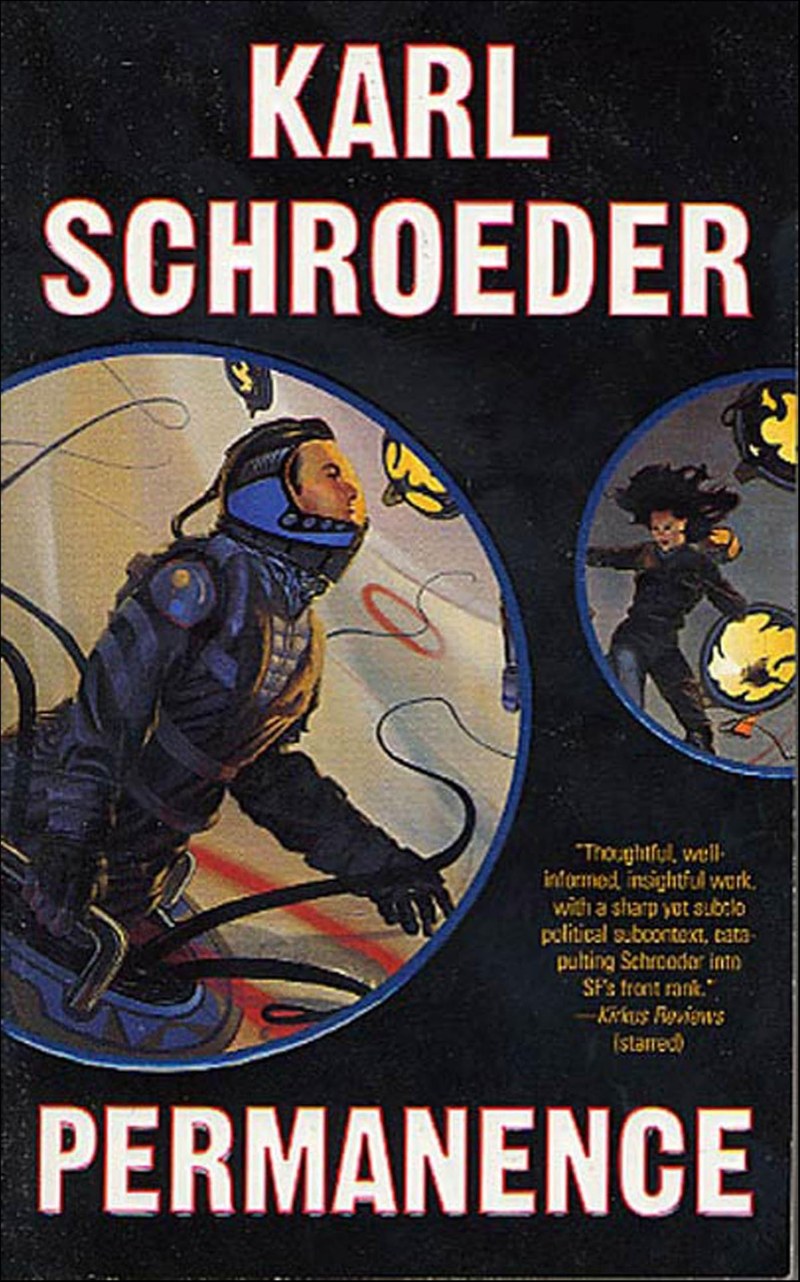
Permanence is classical Big Dumb Object space opera, with weaknesses in characterization and plotting papered over with quick writing and some actually interesting ideas about deep time.
Rue Cassels is escaping from her abusive half-brother and the tiny cometary mining station she calls home when she stumbles across a find of incredible, mind-boggling wealth. A distant speck of light is not just a chunk of rock, not just a slower-than-light Cycler starship, but an alien Cycler. The discovery tosses Rue into the deep end of human politics.
Small-town girl Rue is a mite out of her depth (despite deep wells of cunning, decency, and resilience), and xenoarcheologist Michael Bequith becomes a secondary point of view. Bequith is much more interesting than the standard YA protagonist Rue. He’s the human fixer for the truly gifted Dr. Herat, but both of them have become disenchanted with their discipline. For decades, humanity has been searching for aliens that they could have diplomatic relationships with. However, while life is common, sentient technological life is incredibly rare. The handful of existing equivalent species will have nothing to do with humans out of various forms of revulsion: Autotrophs find the fact that we eat grotesque. Slyphs regard altering the environment to suit you rather than vice-versa a sin worthy of genocide. And there’s a species of nomadic interstellar solipsists. Every other species is dead, nothing more than ruins, many of them wiped out 65 million years ago by a theorized empire of Von Neumann berserker probes called the Chicxulub.
Herat has about given up hope, and so has Bequith. His academic work is a cover for his banned religion of NeoShintoism, which uses AI and VR to capture the Kami of alien worlds, but an experience on a ringworld fragment has left Bequith profoundly shaken.
Rue’s Cycler, the Envy, represents a lot of hope. For Rue, it’s wealth, freedom, and a lifeline for her civilization based in the dark halo worlds, which have been bypassed by the FTL ships of Earth’s Rights Economy. For Bequith, it’s a chance to find his faith again. And for Admiral Chrisler of the Right’s Economy, it’s a chance to win a war that his side is losing via unloosing automated weapons, whatever the cost.
The parts that I found most interesting concern the Right’s Economy and the Chicxulub. The Right’s Economy is a nightmare of DRM, where everything has a price and money is funneled upwards to Right’s Owners back on Earth. Even military starships require constant microtransactions to operate. Most people find this awful, and a growing rebellion is winning the war. Yet some kind of unified government is necessary to prevent humanity from splintering into transhuman fragments. (Notably, Rue is off-baseline. Growing up on a cold and dim cometary hab means she finds ordinary light and heat blinding and stifling. Unclear how much is genetics and how much is just adaptation). And both the Rights Economy and the rebels, using FTL ships that only work around major stars, would leave Rue’s home of the Cycler Compact habitats to wither and die.
The sweep of big ideas makes up for some, well, not bad characterization, but not exactly great characterization and plotting. Rue, for all her good qualities, gets by mostly on luck. Some of which is expected (hey, we need an inciting incident of finding the starship), some of which is earned (and she should be able to turn it on), but there’s one chance drift into a secret rebel base which really stretched my credulity. The Rights Economy seems like a bad joke, but given that this book came out in 2002, the iTunes Store opened in 2003, and the Oblivion Horse Armor DLC fiasco happened in 2006, Schroeder was weirdly prescient—an apt bit of writing given that he’s also a serious futurist.