
Solenoid
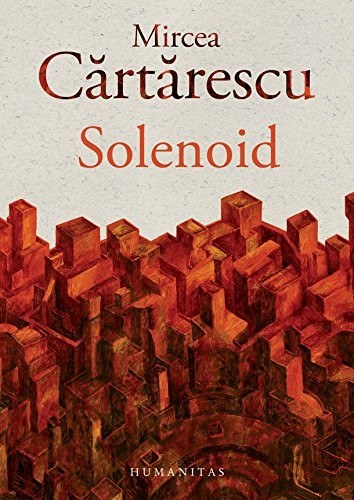
Solenoid is an Eastern European version of Gravity’s Rainbow, an immense paranoid web of personal fantasy and historical curiosity. Our narrator is a teacher of Romanian literature at a school in Bucharest. This story, his diary, slips back and forth from the mundane absurdity of his job, to the anomalies of his personal history, to a fantastic fugue of dreams and grand destinies.
Dividing these levels is unfair, impossible, but I must try. I enjoyed most the comedy of School 86, where classes are taught in rooms like √-5 Ω, the principal tells all the teachers that being married is worse than being hanged (only a little), and government-ordered collection of glass and paper by the students creates a citywide black market where entire factories are devoted to producing junk paper that is immediately recycled and jars are worth more empty than full. Our narrator is terrified of his students, seeing them as an entirely different species, and also bemoans the physical abuse and rote recitation that passes for education at his school.
His own past is strange enough. He dreamed of being a writer, until his epic poem The Fall was brutally critiqued at a literary workshop. He had a twin who was abducted for medical experimentation when they were a year old, and then was raised as a girl by his mother for several years. He spent his childhood being injected with antibiotics, having his teeth drilled and filled, and being in a bizarre tuburculosis sanitarium. Reality has always felt like a false shell, with dreams and the strange visitors within them being more real than the physical. Words are both ultimate truth and ultimate falseness. He was once married, but his wife went mad, or was slowly replaced by an alien being that looked just like her. Now his life is a rut, a handful of baby teeth, an increasing stack of ink-sodden journals.
This is all connected to Bucharest, which is described as a city created already ruined, a grand unified design like Brasilia or St. Petersburg, with the ravages of time built in. Bucharest rests atop the solenoids, six copper braids with geomantic powers, one of which lies directly beneath the narrator’s house. This is all connected to the historical Boole-Hinton-Voynich family. Of logician Boole’s daughters, Alice Boole Stott made important advances in Charles Hinton’s four-dimensional shapes, tesseracts which were a brief Victorian fad. Ethel Voynich wrote a novel, The Gadfly, which was popular in the Soviet Union, and moved in revolutionary circles. Her husband, bookseller Wilfrid Voynich, lent his name to the infamous undeciphered Voynich manuscript. This real history is linked to the fantastical, buildings that warp space and time, statues that come to life, protest movements against the idea of death and suffering.
The writing is dense and lush, but the novel itself is like one of its impossible buildings, spiraling in to a revelation of darkness rather than light.