
The 13th Valley
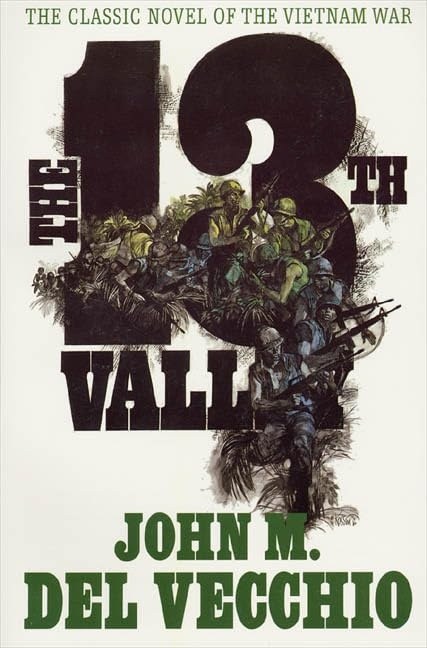
The 13th Valley is a Vietnam War novel that follows closely in the footsteps of Norman Mailer’s The Naked and the Dead. The difference is that Mailer was one of the titans of 20th century American literature, and Del Vecchio is a fine author, but he’s not Mailer.
The story follows Alpha Company, part of the 101st Airborne, through an operation into the titular 13th Valley, a remote highland area near the more infamous A Shau. Our three main viewpoints are Chelini/Cherry, just arrived and anxious to prove himself; Daniel Egan, a hardcore boonierat soldier who becomes Cherry’s mentor; and Lieutenant Brooks, their commanding officer, an intellectual Black man.
The story is based on Del Vecchio’s experiences, he was an army combat correspondent and has a Bronze Star, and the best parts of the writing are the little sensory details of Vietnam. The agonizing tension of combat marches, inch by inch through torturous hilly jungle with death moments away. Damp, heat, filth, jungle rot, leeches, and all the other indignities boonierats faced. And also some of the touches of humanity, like Egan whipping up an actual feast out of C-ration ingredients.
Where the novel stumbles is in its philosophical ambitions. Brooks ponders the meaning of war, questioning his men on the linguistic origins of the conflict. Various soldiers jaw over race in America, and what it means for Black men to be fighting a white man’s war. I appreciate the presence of Minh, a Vietnamese Kit Carson Scout (Communist defectors attached as translators to American units), but his arguments that the Americans should get out of his country and let the Vietnamese lose the war themselves feel more like a prepared statement than an authentic characterization.
The dialog is both a high and low point. The highs are the language of grunts, a mix of profanity, slang, and radio jargon that is utterly of a time. The lows are attempts at dialect, which I personally think is an affectation that should be left in the 19th century. At times, the characters declaim in long philosophical paragraphs, perfectly organized thesis-antithesis-synthesis that’d be hard to assemble at the seminar table, let alone on day five of a combat operation.
Del Vecchio does his best to capture the hallucinatory chaos of combat, though I’m not sure it’s one of those things language can capture. Cherry, in particular, becomes a beast, charging through fire, throwing grenades, killing and being saved from certain death. And while sometimes battle is cinematic, mostly death is random and awful, bolts from the blue which whittle down Alpha company. Del Vecchio is absolutely clear that every name on the black wall in Washington DC (and the unlisted millions of Vietnamese, Cambodians, and Laotians) was a life destroyed, dreams forever unfulfilled, a universe lost.
Speaking of dreams, the story spends a lot of time in the characters’ memories, mostly flashing back to women. This is realistic and generally kind of weird. Likewise, each chapter is followed by an official summary in the form of an operation report, which does help contextualize the action and show how little the most important day in someone’s life matters to the Army and the history.
Ultimately, I admire the ambition, but the execution leaves something lacking. This is a solid novel, but it’s a long way from its inspiration, or the first tier of novelistic memoirs, like Dispatches, Chickenhawk, or Matterhorn.