
The Armageddon Letters: Kennedy, Khrushchev, Castro in the Cuban Missile Crisis
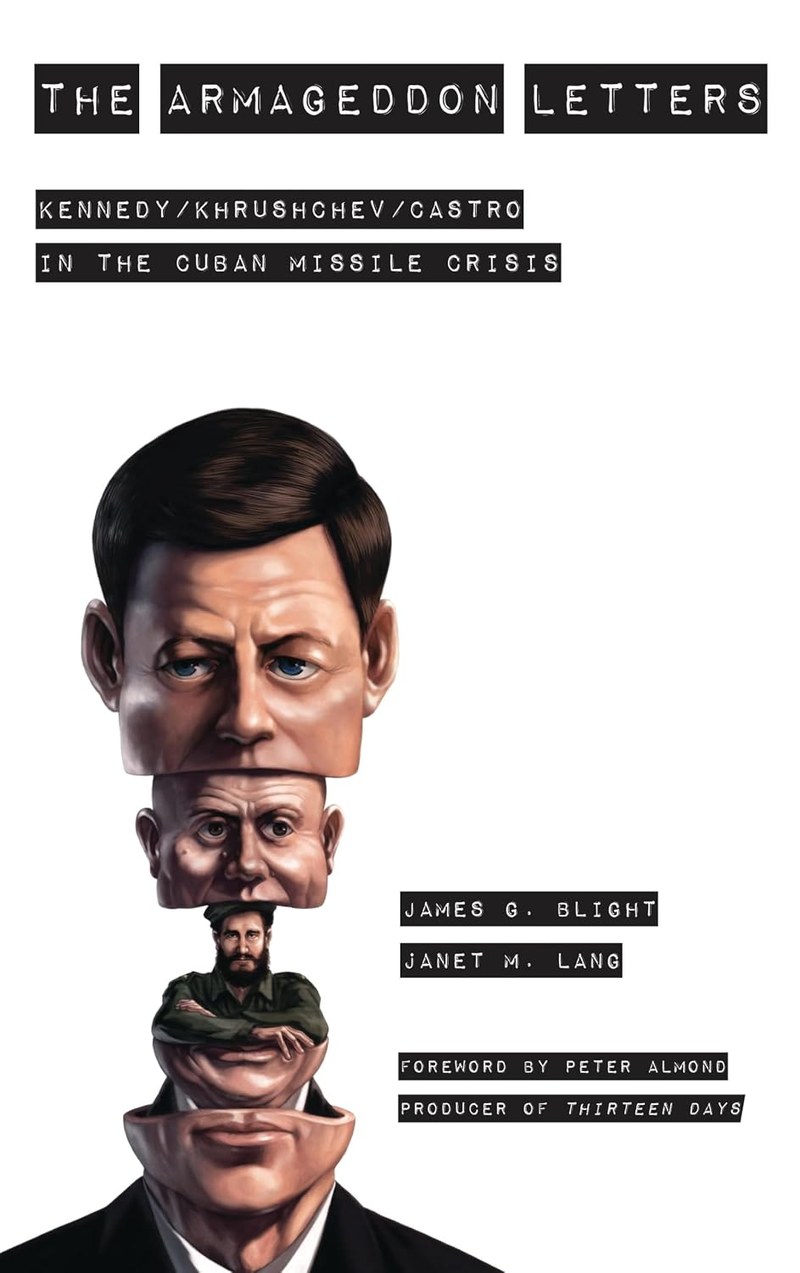
Blight and Lang were two of Robert McNamara’s closest collaborators in the great project of his twilight years: using the lessons of the Cuban Missile crisis to push for nuclear disarmament. They organized McNamara’s last significant public appearance, and this book is their attempt to “carry the fire” of his mission. It’s an unconventional history, structured around about 40 letters between Kennedy, Khrushchev, and Castro, amplified by contextual information, mostly in the form of dialogues between these leaders and their advisors, and given some dazzle by short dramas and comic books introducing each section. And sadly, it is a miss.
McNamara’s conviction was that the world came within a hair’s breadth of armageddon in 1962, that we avoided catastrophe mostly by luck, and given that humans are fallible, every day that nuclear weapons exist is a chance for some error or miscalculation to trigger general thermonuclear war. And looking at the leadership of America, Russia, and Israel in 2026, we need a lot of luck. On a long enough timescale, catastrophe is unavoidable. The bombs must be dismantled.
To the history itself. Blight and Lang put the immediate origins of the crisis in the Bay of Pigs fiasco, where a CIA backed army of Cuban exiles utterly failed to invade Cuba and overthrow Castro. Khrushchev had a clever idea to bolster this outpost of socialism in the Western hemisphere by giving them nuclear weapons, a balance to the American intermediate range missiles in Turkey. U-2 reconnaissance discovered the missiles before they became active, and Kennedy announced a “quarantine” of Cuba, since a blockade is an act of war, and set US forces to DEFCON 2, one step short of actual war.
Both Kennedy and Khrushchev immediately recognized that nothing around Cuba was worth risking global annihilation. Perhaps the biggest surprise is that these two ardent Cold Warriors recognized that they had a unique partnership in not blowing up the world. The trick was to get the missiles out of Cuba in a way that preserved face for everyone concerned, and in this, Castro was the wildcard. In the grip of revolutionary fervor, Castro was absolutely willing to sacrifice himself and his country. The basic misapprehension was that Castro saw himself as under massive American threat, and after Bay of Pigs, Kennedy wanted Cuba off his agenda. The minimal covert action was primarily for domestic politics.
There’s something powerful about the actual words these historical figures used, but this book attempts and doesn’t grasp the psychological weight of the moment. Sure, the world could be destroyed. What’s for dinner? As an amateur strategist, I fully believe that a “winnable” nuclear war is a dangerous myth. Yet, even with all its conventional arsenal, Russia still hasn’t destroyed Kyiv over 4 years into its Three Day Special Military Operation, and a single nuclear missile, if they chose to escalate, could do so. But if there were only one nuclear power, the ability to wipe out the cities of its adversaries without significant retribution would be very tempting to would-be conquerors. Mutually Assured Destruction has worked, so far, and even North Korea can make a nuclear bomb these days. Putting the genie back in the bottle is very very hard.