
The Chosen Ones: Test Pilots in Action
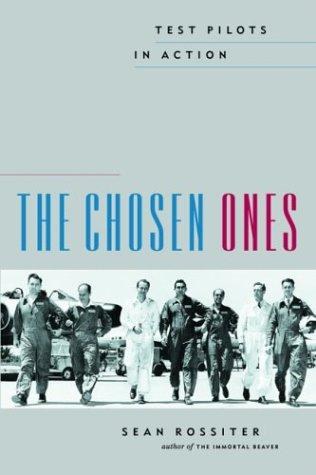
The Chosen Ones is a workman-like account of test pilots working for Avro or De Haviland Canada in between roughly 1947 and 1965. This book is the polar opposite of Wolfe’s The Right Stuff (heh, Canadian pole joke). Rather than a New Journalism thriller focusing on cokcpit masculinity, the 10 Canadian test-pilots featured here are quiet professionals engaged in a precise and dangerous trade.
Avro and De Haviland were strong companies at the time, flush with wartime contracts and ready to prove themselves against competitors in the US and UK. Avro went high-tech, constructing the early jet night fighter the CF-100 Canuck, and embarking on a host of research projects that went nowhere. The VZ-9 Aircar was a VTOL flying saucer. The C102 Jetliner was the world’s second jet passenger airplane, flying nine days after the Comet, and without the latter’s fatal metal fatigue problem, yet put on hold due to the military priority of the CF-100. The CF-105 Arrow is the hauntology of Canadian aerospace, a Mach 2 super-interceptor that was abruptly cancelled in 1959, leading to the death of Avro as a company and the scattering of its high tech workforce. Avro offers a fascinating case of high tech “what-if”.
De Haviland went the opposite way, focusing on very well-made conventional planes with exceptional durability and take-off performance. The DHC-2 Beaver, DHC-3 Otter, DHC-4 Caribou, and DHC-5 Buffalo were a series of related “bush” cargo airplanes, many of which are still in service 60+ years later. A Beaver on floats is an iconic part of the Canadian wilderness. De Haviland Canada suffered the normal ups and downs of an aviation company, being taken over by the government, privatized and sold to Boeing, and later incorporated into Bombardier.
The general thrust is an effort by Canadian test pilots to prove themselves, both against the tutors in the British Empire Test Pilot School, and their own skeptical company engineers. Good test flying requires taking an aircraft to and past its safe limits, and coming back with data. Two anecdotes stick out. The first is the general career of Jan Zurakowski, a Polish pilot and WW2 veteran who everyone agreed was the most precise acrobatic pilot of the era, a showman with a natural understanding of aerodynamics. Zurakowski invented the Zurabatic Loop, which involved taking a Glouster Meteor in a 90 degree climb, cutting one engine to go into a knife-edge spin, cutting the other engine as the plane spun through 540 degrees, and recovering and flying out. Allegedly, five Meteors were lost in a single week as lesser pilots attempted to follow Zurakowski.
George Neal and the Caribou demonstrate what being a test-pilot is truly about. The prototype Caribou had a narrow load center-of-gravity, so the next model had a 4 foot fuselage extension. George Neal was taking the plane on a test-flight, when the elevators began to flutter uncontrollably and broke off entirely. His co-pilot jumped out. Neal took the time to purge the fuel system and shut off the electrical system. He bundled his flight notes into his iconic leather baseball cap and stuck everything under the seat. Only then did he jump. Thanks to Neal’s careful attention, engineers were able to determine from the notes and wreckage that the extension created a harmonic mode in the elevator control cables. The controls and elevator were redesigned, and Neal even kept his hat.
This is an informative book, and probably the best single collection on its subject. But how much do you really care about Canadian test pilots in the 1950s?