
The New Economics for Industry, Government, Education
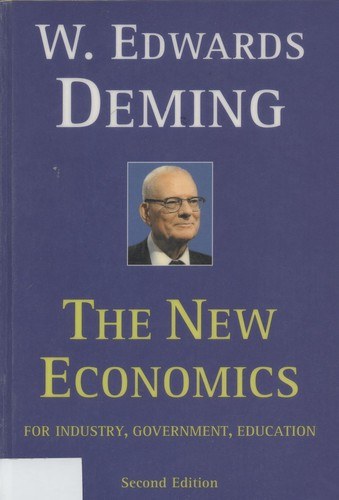
The New Economics is a series of flashcards, carrying telegraphic versions of Deming’s Big Ideas. Deming, of course, was an American economist who helped train the Japanese in a new style of quality management that arguably led to decades of Japanese dominance in high technology. His ideas lay behind the Toyota Production System, and the maligned TPS reports of Office Space. He also passed away in 1993, just as Japan entered its lost decade. The New Economics was his last book.
The center of his ideas holds up. Think of a company as a system, with management’s role being to organize the system for quality. Understanding that there is natural variation in a system, and don’t go chasing randomness. Treat workers as human beings and approach their psychology as high-morale team members, rather than creating self-defeating ‘meritocratic’ ranking systems.
But this book is scattered, organized anecdotally rather than thematically. It’s one thing to proclaim that ‘the firm is a system’, but Deming lacks the theoretical tools to describe how systems self-organize and can be governed. It’s a little unfair to argue that a dead man should be current with the latest research, but this book would be so much better in conversation with the Sante Fe Institute (see Mitchell’s Complexity: A Guided Tour, John Boyd’s OODA loop (Richard’s Certain to Win, or even the intersection of epistemology and ecology (Miller et al. 2006. Epistemological Pluralism: Reorganizing Interdisciplinary Research, particularly the figure on the adaptive cycle from Reorganization, Growth, Conservation, and Release).
Deming is still a name to conjure with, but there are likely better books on the area.