
The Rising Sun: The Decline & Fall of the Japanese Empire, 1936-45
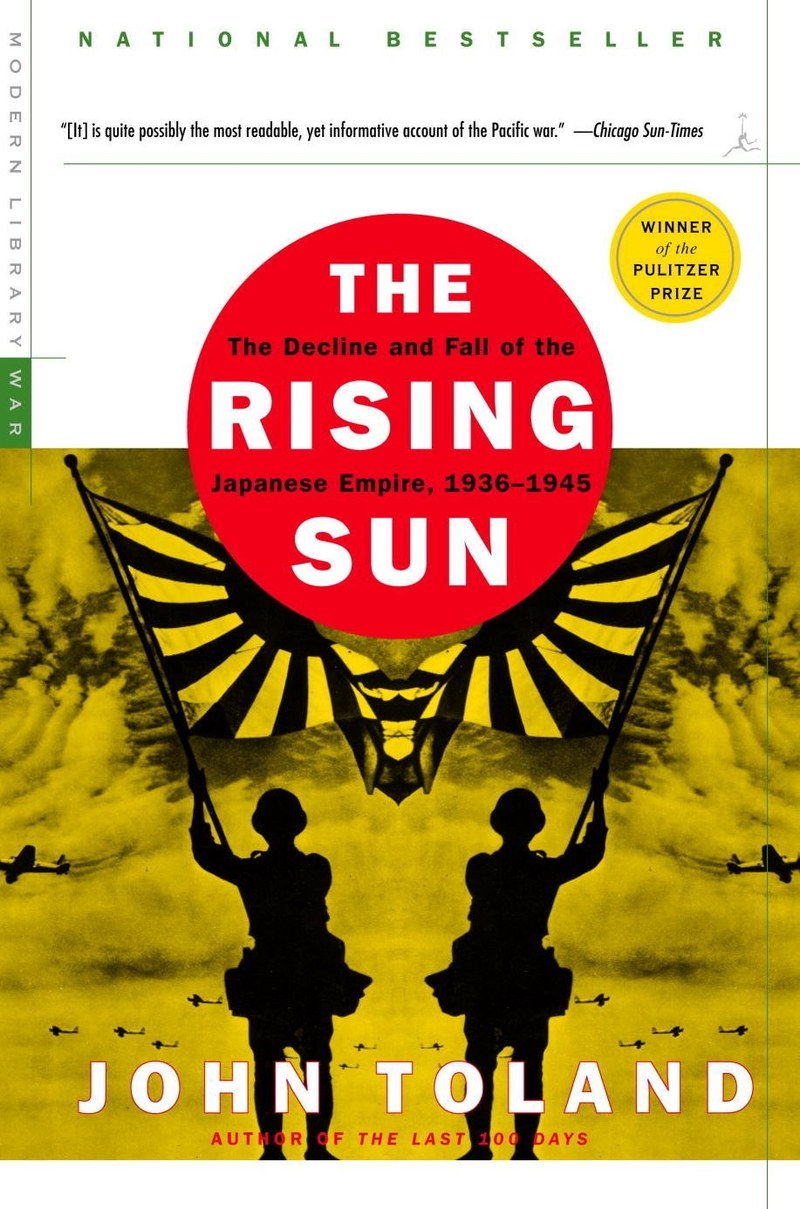
The Rising Sun is a deserved classic, one of the first popular accounts of Japan’s side of the Second World War. Toland takes us from the highest levels of Tokyo policy-making to the frontlines of the deadly island battles of the Pacific campaign, humanizing an enemy that was derided in racist terms during the war.
Japan in the run-up to the war was beset with problems. As an island nation, it imported almost everything and were vulnerable to blockades and sanctions. They were stuck in a grinding counter-insurgency war in China. And a cult of reconstructed bushido emphasized glorious battle as the solution to all problems. Ambitious junior officers, or fear of ambitious junior officers, pushed Japan to the brink of war against America and Britain. In 1941, with Nazi power at its height, the militarists decided that if they did not act now they would be unable to share in the spoils of a fascist victory, and as American industrial power grew this was the only chance to knock America out of the war.
Toland builds the tension leading up to Pearl Harbor masterfully. The attack achieved total tactical surprise, though strategically America expected an attack somewhere. But it was a sneak attack through a bleak comedy of errors in decryption and translation of the declaration of war, which was supposed to arrive just before the first wave of bombers. The attack killed thousands, led to Roosevelt’s famous ‘Day of Infamy’ speech, and turned American public opinion decisively against Japan. It would be a hard war.
Following victories in Singapore and the Philippines had Allied fortresses falling like dominoes, and 1942 saw Japan in charge of the furthest extent of what would be the Greater East Asia Co-Prosperity Sphere. But Imperial Japan had two cults, the first that of bushido and the Emperor, and the second that of the Decisive Battle. In 1905, at the Battle of Tsushima, Admiral Togo annihilated the Russian fleet and caused their collapse. Both the Navy and the Army would seek one great battle, where exceptional bravery would carry them forwards.
But America was not Tsarist Russia. At Midway, American carriers dealt a mortal blow to the Kido Butai. At Guadalcanal, a war of attrition ripped the guts out of the elite forces of the Navy and Army. From there on out, it was a terrible war of attrition. On island after island, starving under-supplied Japanese forces died almost to the last man.
By 1945, defeat was evident. Nazi Germany was being ground to dust. Iwo Jima and Okinawa had fallen. General LeMay’s XXI bomber command was destroying a city a night. The desperate tactics of kamikaze attacks could not turn back American invasion fleets. Yet fear of a military uprising prevented serious peace-feelers. Even after two atomic bombs, junior officers staged a coup to prevent the Emperor’s statement of surrender from being broadcast.
I’m sure that in the subsequent decades, better archival work has changed the historical argument. But Toland had access to the subjects themselves, and the voices from the front are stark and terrifying. This is a long book, and even so I wish it had more on China and Army-Navy rivalries, but for anyone interested in the Pacific Front it is the first stop.