
Why the Allies Won
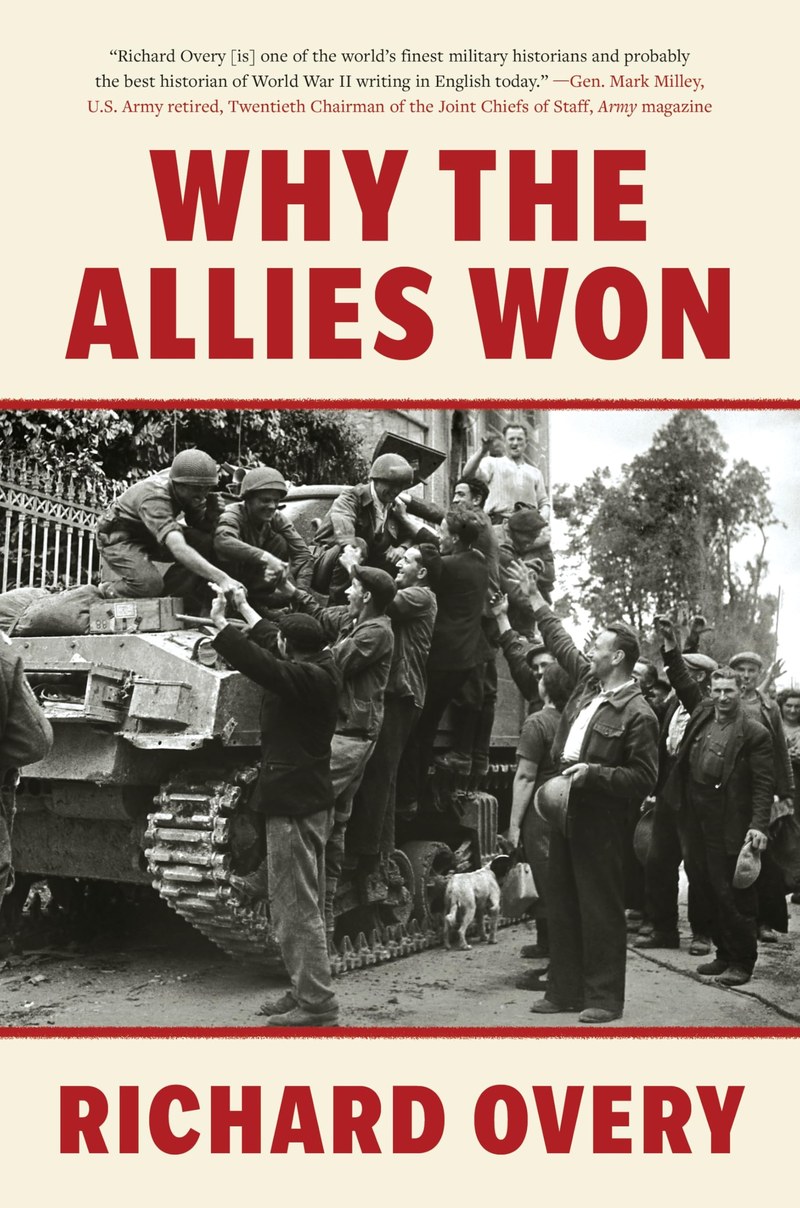
Why the Allies Won is a strong, if somewhat repetitive book, that tells the story of the great Allied victory, while also somewhat contradicting its stated thesis. Overy tries to argue against Whiggish triumphalism and point to the contingency of key battles, and the costly process of learning to fight that led to turning point victories in 1943, rather than simply gesturing at the immense material imbalance in favor of the Allies and the weaknesses of the Axis command structure. Yet in closing, those two factors are determinate.
The major campaigns are the Battle of the Atlantic, Stalingrad-Kursk, the combined bomber offensive, and finally the invasion of Normandy. In each of these, the Allies went from taking hefty losses, to parity, to eventually achieving an attrition that ripped the heart out of Axis resistance, leading to a long, bloody, and yet inevitable conclusion.
The basic fact is that the Allies outproduced the Axis by an order of magnitude in all the key inputs of modern warfare: ships, tanks, artillery, aircraft. Certainly, numerical parity wasn’t enough to lead to victory. The Allies often had parity in disastrous early battles. But when the US is launching hundreds of major warships in a year versus a few dozen for the Japanese, well, there’s only one way that struggle will go. Overy also gives the majority of credit to the resilience and sacrifice of the Russian people, who gave most of the blood that defeated the Nazis. Though this was not a simple matter of unending hordes, the Red Army skillfully concentrated force and used misdirection to achieve local supremacy with each offensive, in classic Clausewitzian style.
Most surprising to me in terms of new info was the shocking inefficiency of the Nazi war machine. The Nazis were perhaps 25% to 50% efficient at turning the same amounts of raw materials into tanks and planes as the Allies. This is especially impressive, given that the Soviet Union had to evacuate most of its heavy industry and rebuild east of the Urals. The Nazis attempted to rationalize production in 1943, but by then the combined bomber offensive added enough friction to ensure that numbers would never meet their necessary targets.
On the political side, only opposition to Hitler held together the odd bedfellows of Churchill, Roosevelt, and Stalin. Hitler’s megalomania and refusal to delegate or take advice meant that German strategy became haphazard and poorly coordinated. The MilHist thread on the SomethingAwful forums uses the phrase “gay black Hitler” to describe the necessary conditions for a Nazi victory. A reasonable Hitler with reasonable war aims would simply have not started the war. Imperial Japanese high command knew the war was lost by 1943, 1944 at the latest, but were unable to coherently advance a position for surrender that might have avoided the mass destruction of Japanese cities via strategic and nuclear bombing.
Certainly, there were points that hinged on the smallest things, yet would a reversal have changed things? The Battle of Midway hinged on ten bombs hitting Japanese carriers. But the mass of Essexes would have sailed into the Pacific in 1944 even if Enterprise and Hornet had joined Yorktown on the bottom, and the Kido Butai had triumphed. A victory at Stalingrad or Kursk would have seen another defensive line a few hundred kilometers back. The Battle of the Atlantic and the strategic bomber offensive were both fundamentally attritional, and while new weapons and doctrine turned the tide in both cases, it was the production margin that ensured the Axis never got back up after. Normandy was the chanciest one. Eisenhower’s decision to have D-Day proceed on June 6 was a daring break in bad weather. If he’d picked the next opportunity on June 19th, the shocking storm of that day would have wrecked the landing. Perhaps political will for a second landing would not have been there, but I’m skeptical that one more defeat would have broken the Allies.